Introduction
Launching a scooter-sharing service is not only about software, branding, or getting vehicles on the street quickly. The hardware itself has a direct impact on operations, maintenance costs, customer experience, and the long-term sustainability of the business.
One of the most common mistakes new operators make is choosing consumer scooters instead of models built specifically for rental operations. At first glance, the difference may not seem significant. In reality, it affects almost every part of the operation.
Based on what we see across shared mobility projects, choosing the right scooter from the beginning can save operators a significant amount of time, money, and management challenges later on.
Consumer scooters vs sharing-ready scooters
A scooter designed for personal commuting and a scooter designed for commercial rental operations are two very different products.
Consumer scooters are typically built for:
- one rider
- limited daily usage
- indoor storage
- controlled charging conditions
- lighter day-to-day operational pressure
Sharing-ready scooters are built for:
- intensive daily usage
- multiple riders per day
- outdoor exposure
- remote fleet management
- frequent charging cycles
- constant parking, movement, and handling in public environments
This difference becomes visible very quickly once operations start scaling.
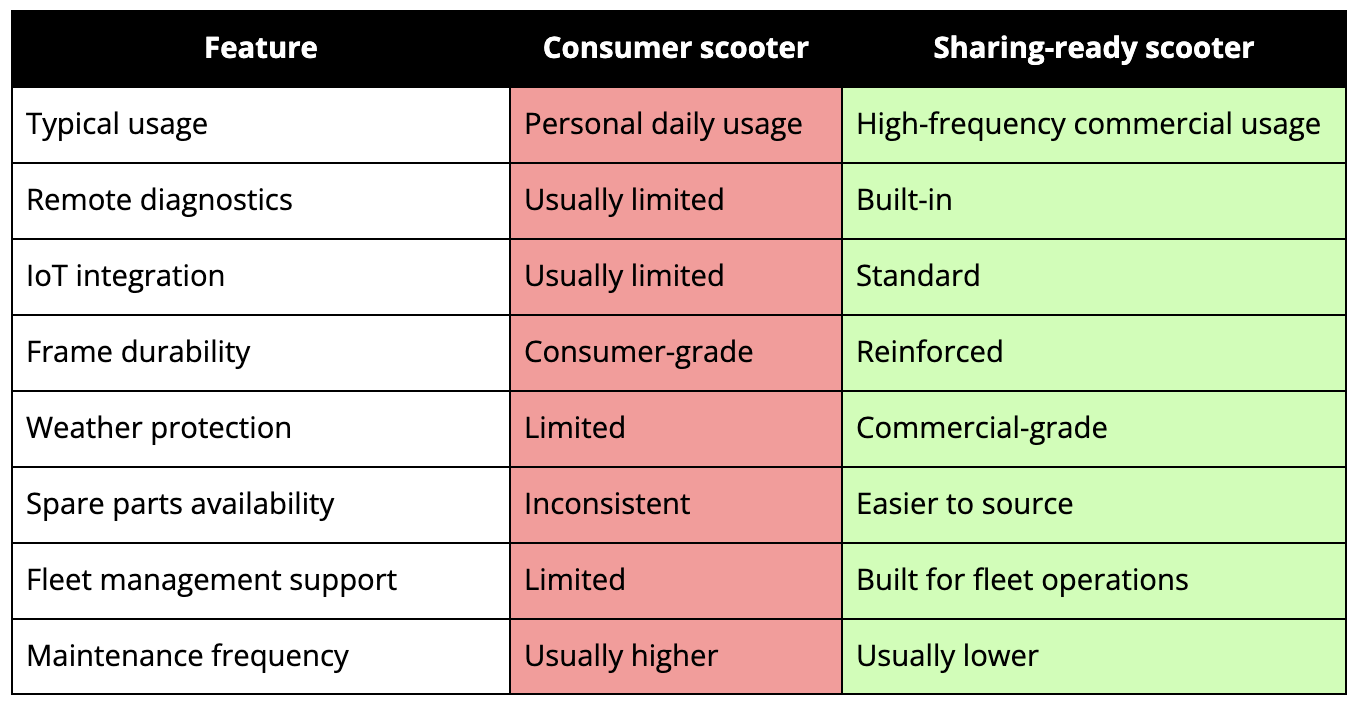
For small pilot projects, consumer scooters may initially seem attractive because of the lower purchase price. But in rental operations, cheaper hardware often creates higher operational costs over time.
What actually matters in rental operations
When evaluating scooters for sharing services, the most important factors are usually not top speed or marketing specifications - operational reliability matters far more.
1. Durability
Rental scooters experience much heavier usage than privately owned vehicles.
They are exposed to:
- curb impacts
- improper parking
- rough road conditions
- vandalism
- weather exposure
- constant charging cycles
- multiple riders every day
Commercial scooters are typically reinforced in key areas such as the frame, suspension, stem mechanism, and wheels. This helps reduce downtime and maintenance frequency. For operators, durability directly affects fleet availability.
2. Built-in telematics and IoT integration
Modern shared mobility operations rely heavily on telematics.
Operators usually need:
- GPS tracking
- remote lock and unlock
- ride monitoring
- real-time vehicle status
- battery monitoring
- remote immobilization
- geofencing support
This is one of the main reasons professional sharing-ready scooters are preferred in commercial operations.
Manufacturers such as OKAI, Segway-Ninebot, and NAVEE offer models specifically designed for integration with fleet management platforms and IoT systems.
Many commercial models already include:
- telematics hardware
- IoT controllers
- SIM connectivity
- BLE support
This simplifies both integration and daily operations.
3. Waterproofing and outdoor usage
Scooters used in sharing fleets spend most of their time outdoors. In many markets, vehicles must operate through:
- rain
- humidity
- dust
- heat
- temperature fluctuations
Weak waterproofing often leads to charging issues, controller failures, display issues, and battery damage.
For operators, weather resistance is not simply a technical detail - it directly impacts fleet reliability.
4. Spare parts and serviceability
This is one of the most underestimated topics during fleet planning.
Even good scooters require maintenance. The difference is how quickly and efficiently repairs can be completed.
Before purchasing vehicles, operators should evaluate:
- local spare parts availability
- repair complexity
- standardization of components
- local service partners
- delivery times for replacement parts
A scooter that is slightly cheaper upfront can become problematic if every repair requires long delivery times or specialized components.
5. Battery strategy
Battery operations become increasingly important as fleets grow.
Operators should think about:
- removable vs fixed batteries
- charging logistics
- warehouse operations
- charging staff workload
- battery lifecycle
- operational downtime
In dense urban environments, swappable battery systems can significantly improve fleet efficiency.
Examples of professional sharing-ready e-scooters
There is no single “best” scooter for every market. The right choice depends on the business model, city infrastructure, climate, operational budget, and local service capabilities.
However, several commercial scooter models are widely used across shared mobility fleets because they are designed specifically for rental operations and support telematics integration.
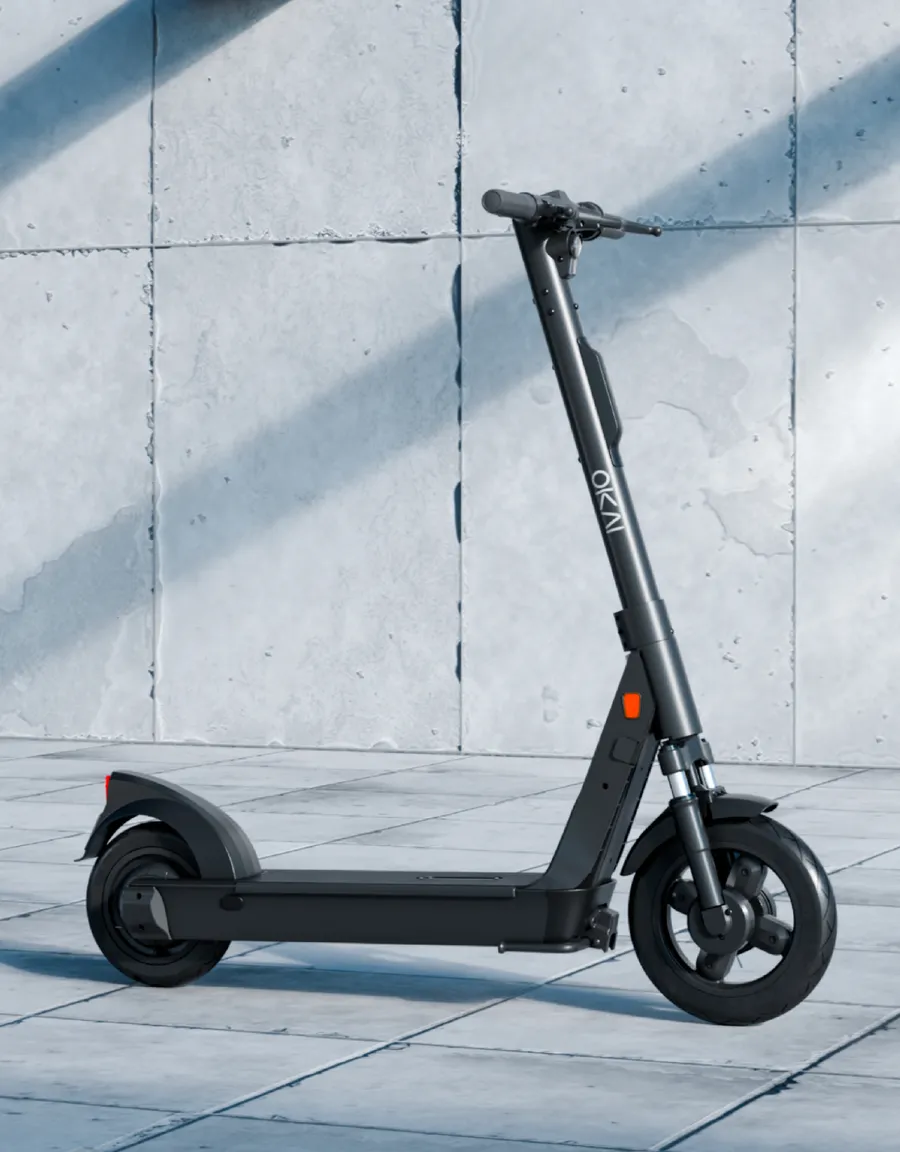
OKAI ES400 Series
The OKAI ES400 line was developed specifically for commercial fleet usage and is widely used in shared mobility projects worldwide.
Operators often choose these models because they offer:
- travel range of up to 55-60 km depending on riding conditions and configuration
- top speed of up to 25 km/h
- swappable batteries for faster fleet operations
- built-in IoT and GPS support
- reinforced commercial-grade construction
- water and dust protection
- dual braking systems and bright lighting for rider safety
The scooters are designed for intensive daily usage and short-to-medium urban trips.
Segway-Ninebot Max Pro Series
The Segway Max Pro series became one of the most widely used scooter lines in shared mobility due to its balance between durability, ride comfort, and operational simplicity.
Common features include:
- travel range of up to 60 km
- top speed of up to 25 km/h
- swappable battery systems
- integrated telematics support
- reinforced frame construction
- maintenance-friendly design
- large tires and dual braking systems for improved safety and ride stability
These scooters are commonly used in both free-floating and station-based operations.
NAVEE Commercial Models
NAVEE commercial scooters are increasingly being used in modern mobility fleets and are often considered by operators looking for newer fleet hardware alternatives.
Depending on the model, they may offer:
- travel range of up to 50-65 km
- top speed of up to 25 km/h
- integrated IoT support
- larger battery capacity
- reinforced construction
- suspension systems for improved comfort
As with any fleet hardware, operators should evaluate not only specifications, but also spare parts availability, local service support, and compatibility with their fleet management platform.
Why cheap scooters become expensive
Many first-time operators focus mainly on purchase price. This is understandable during the early stages of a project.
But in practice, operational costs usually matter far more than the initial hardware price.
Cheaper scooters often lead to:
- more repairs
- shorter vehicle lifespan
- higher downtime
- unstable telematics performance
- battery issues
- increased technician workload
- inconsistent customer experience
In shared mobility, the cheapest scooter is rarely the cheapest operationally.
Software and hardware must work together
Even strong hardware can create operational challenges if the software ecosystem is weak or incompatible.
Fleet management platforms should support:
- telematics integration
- real-time monitoring
- geofencing
- remote vehicle control
- battery monitoring
- ride analytics
- operational automation
When hardware and software are properly integrated, operators can reduce manual work, improve fleet visibility, and scale operations more efficiently.
At CT Mobility, the platform supports integration with multiple telematics providers and sharing-ready scooter models used in commercial fleets worldwide. In addition to branded iOS and Android applications, the platform also includes a full web application for users. This gives operators additional flexibility and reduces reliance on App Store and Google Play distribution.
The platform also supports:
- QR code ride start
- keyless vehicle access
- digital onboarding and verification
- real-time fleet management
- subscription and rental models within one ecosystem
Final thoughts
Launching a scooter-sharing service is a long-term operational business. Hardware decisions made at the beginning often determine how stable and scalable the project becomes later.
For most operators, professional sharing-ready scooters are the safer long-term investment, even if the upfront cost is higher.
Before purchasing vehicles, it is worth testing several models, evaluating serviceability, and confirming compatibility with the planned telematics and software infrastructure.
A smaller pilot fleet with the right hardware is usually a better starting point than scaling quickly with vehicles that are not designed for commercial operations.
Launch your vehicle sharing app in just 15 days with CT Mobility!
No setup fees. Unlimited features.
Free trial period.





.png)