In shared mobility and digital vehicle rentals, customer dissatisfaction rarely starts with pricing or fleet availability. It begins at the moment something goes wrong and the system feels silent. A trip cannot be ended, a vehicle does not unlock, or a charge appears without explanation. These moments define the user’s perception of the service far more than the ride itself.
In such situations, users are not looking for empathy or long explanations. They want clarity and speed. When they do not get answers inside the app, issues escalate quickly - to phone calls, social media complaints, and public reviews.
This is why in-app support tools, particularly chatbots and scenario-based guidance, are no longer viewed as optional UX features. They are becoming part of the core operational infrastructure of modern shared mobility platforms.
Stressful for users, simple for systems
What makes these situations risky for operators is not technical complexity, but emotional pressure. From the user’s perspective, the issue feels urgent because it often involves money, time constraints, or an active trip. From an operational standpoint, however, most of these cases are rule-based and predictable.
Industry studies across on-demand platforms show that 60–80% of support requests are repetitive and explainable through predefined logic. In shared mobility, this percentage is often even higher due to standardized trip flows, pricing rules, and vehicle behavior.
Why speed matters more than fixing the issue
Frustration grows not because the problem itself is difficult, but because no explanation is provided fast enough. Customer experience research consistently shows that uncertainty causes more frustration than the issue itself.
Users are generally willing to tolerate delays if they understand what is happening. Silence, however, is interpreted as system failure. When a deposit is locked or a trip cannot be ended, immediate feedback becomes critical, even if the issue is not resolved instantly.
Chatbots as operational protection, not replacement
There is a common misconception that chatbots exist to replace human support teams. In practice, their primary role is to protect them.
By handling predictable, high-frequency requests, chatbots reduce inbound calls and ticket volume. This allows human agents to focus on complex, emotional, or legally sensitive cases.
Industry data from transportation and on-demand services shows that well-implemented chatbots can handle 50–80% of incoming inquiries, preventing escalation before human intervention is required.
Building scalable in-app support that stays simple
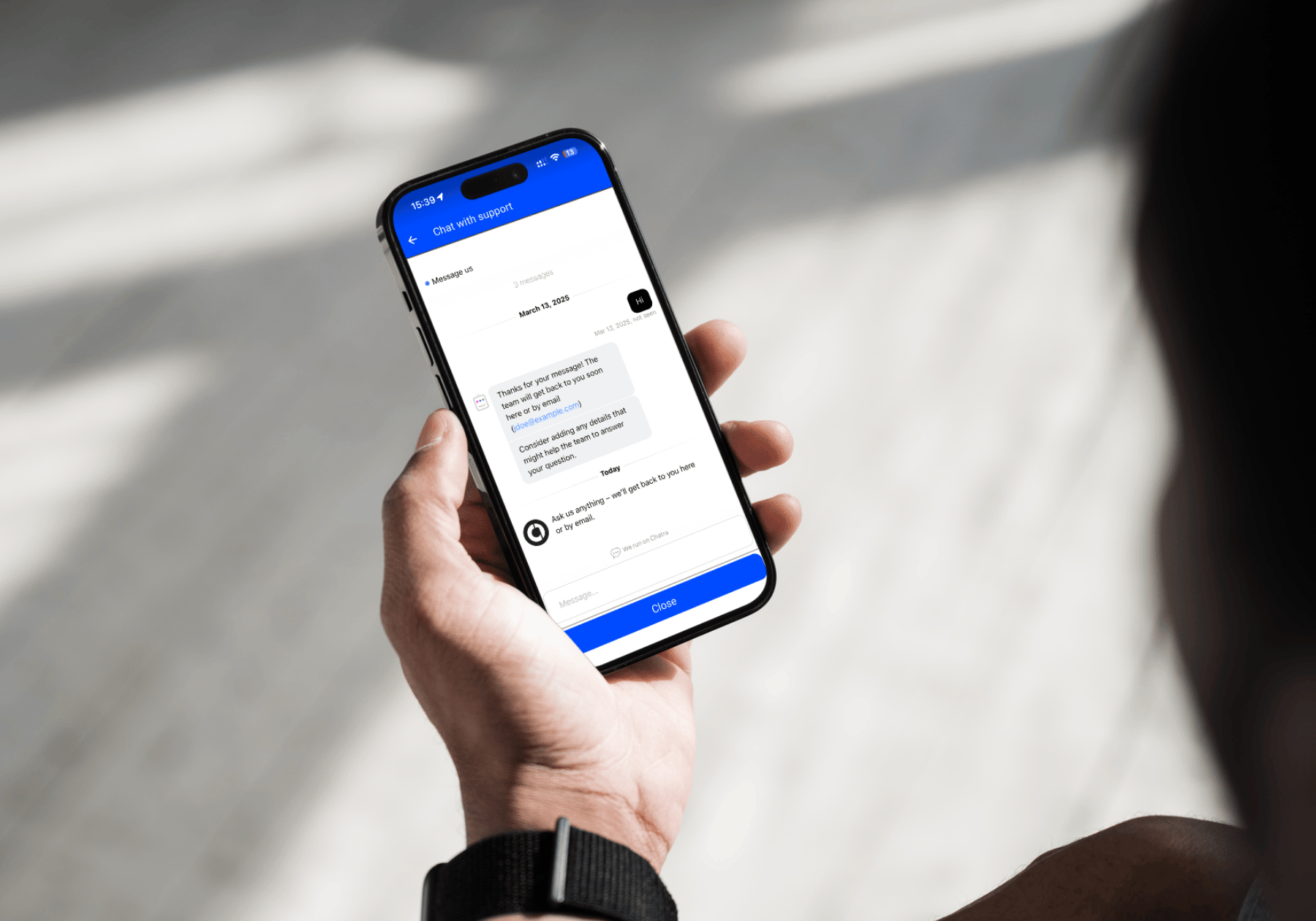
Many mobility platforms choose lightweight in-app chat tools such as Chatra as part of their support infrastructure. Rather than attempting to replicate human conversation with complex AI, these tools are designed around practical operational needs. They combine real-time in-app live chat, basic automation, predefined responses, proactive messages, and smooth handover to human agents when escalation is required.
Lightweight chat tools respond instantly, keep users inside the app, and significantly reduce reliance on phone-based support. Because most mobility-related questions are predictable and scenario-driven, a large share of requests can be resolved automatically without involving an agent.
This has a direct impact on support workload and labor costs. By filtering repetitive inquiries, in-app chatbots allow operators to support growing fleets without scaling support headcount at the same pace. In practice, fewer agents are needed to maintain service levels, even as trip volumes increase.
Cost efficiency reinforces this advantage. Solutions like Chatra offer flexible pricing with relatively low per-agent monthly costs, making them accessible for growing operators. Combined with reduced staffing needs, this allows mobility businesses to control labor costs while still providing fast, near-continuous in-app support.
For shared mobility, the real value of lightweight chatbots lies not in how “intelligent” they appear, but in how effectively they remove pressure from support teams. By resolving predictable issues quickly and preventing unnecessary escalation, they protect both the user experience and the operational budget behind it.
At CT Mobility, we see in-app support not as a feature, but as part of the operational backbone of shared mobility platforms. Through more than 10 years of hands-on experience and real-world deployments across carsharing and micromobility projects in multiple markets, we have seen how fast, contextual support inside the app reduces friction for users and relieves pressure on operations teams. As fleets scale and user expectations rise, the ability to respond instantly - without overengineering - becomes a genuine competitive advantage. In-app support is a core element of building reliable, scalable shared mobility services that perform under real operational conditions.
Launch your vehicle sharing app in just 15 days with CT Mobility!
No setup fees. Unlimited features.
Free trial period.




.png)