To start an e-scooter rental or sharing business you need five things in place, roughly in this order: a business model, permission to operate where you plan to, scooters built for rental with a way to keep them charged, software that unlocks them and takes payment, and a budget that covers the first season. Below is each step, with the questions to ask your city and the cost lines to put in the plan.
The order we'd follow:
- Decide between sharing by the minute and rental by the hour or day, and between docked and free-floating.
- Ask the municipality or the site owner what a permit requires. Do it before you buy anything.
- Pick sharing-grade scooters and a charging method.
- Set up the software: rider app, IoT connection, zones, payments, tasks for the field team.
- Write the budget line by line and test it against rides per scooter per day.
- Launch with a small fleet in one area, watch the numbers for a few weeks, then add vehicles.

Rental or sharing: decide this first
"E-scooter business" covers several different businesses. The vehicles look alike, while the permits, the staff and the software settings differ.
| Model | How the customer gets a scooter | Where it fits | What it asks of you |
|---|---|---|---|
| Free-floating (dockless) sharing | Finds one on the map, scans a QR code, pays per minute, ends the ride inside a parking zone | City districts, large campuses | Permission to use public space, a field team that charges and moves scooters every day |
| Docked (station-based) sharing | Picks up and returns at fixed stations or marked bays | Cities that insist on fixed parking, hotels, residential communities, business parks | Agreed station sites, and docks if you want charging at the station |
| Rental by the hour or day | Books online or walks up to a shop, a hotel desk or a kiosk, and returns to the same place | Tourist streets, beach towns, resorts | A location with storage and charging, a deposit or a card on file |
| Long-term rental | Takes a scooter or moped for a week or a month, often on a subscription | Commuters, couriers, delivery riders | A contract per customer and a replacement vehicle when one is in repair |
If you plan to rent mopeds or e-bikes to delivery riders, the last row is your business, and it runs like a rental fleet. We cover that case on the page about software for delivery bike fleets in the UAE.
New to the term "scooter sharing system"? It is four parts working together: scooters with an IoT module (GPS, a SIM card, a remote lock), a rider app, a back office where you set zones and prices, and people on the street who charge, move and repair the vehicles.
Our advice is to start with one model in one area. A closed site such as a campus or a resort is the easiest first launch, because the site owner gives the permission and the scooters can't wander far.
Own brand, white label or franchise
You also choose how much you build yourself. A franchise gives you an existing brand, app and playbook in exchange for fees, a share of revenue and the franchisor's rules. A white-label platform gives you the app and the back office under your own brand, while you buy the scooters and run operations. Writing your own app from scratch is the slowest route, and we wouldn't spend the first year's money on it.
Before you sign a franchise agreement, ask who holds the city permit and the rider data, and what happens to the fleet if you leave.
Permits and insurance: what to ask the city
E-scooter rules are set country by country and often city by city, and they change. Three examples show how far apart they are. In the UK, rental e-scooters may be used on public roads only in official trial areas, where the local authority appoints the operators and the operator provides third-party motor insurance (GOV.UK guidance). In Germany, every e-scooter on public roads needs a valid insurance plate and a design speed of no more than 20 km/h (eKFV, §1 and §2). In Dubai, the RTA approves the rental operators and e-scooters have to stay on designated tracks in the listed areas (RTA).
So the first meeting is with the transport or mobility department of the municipality, or with the owner of the private site. Go with a list:
- Is shared or rental use allowed at all? Is there a tender, a permit, a cap on operators or vehicles?
- What does the permit cost, how long does it last, and are there fees per vehicle or per ride?
- Where may scooters be ridden and parked? Ask for the map of no-ride zones, slow zones and mandatory parking bays.
- Which rider rules does the app have to enforce: speed limit, minimum age, helmet, licence or riding permit?
- What data does the city want from you, how often and in what format?
- Which insurance is mandatory?
- What happens to a badly parked scooter? Who removes it, how fast, and who pays?
Get the answers in writing. In the UAE each emirate sets its own rules and private communities add theirs; our page on the e-scooter and bike sharing platform for UAE operators shows how those rules turn into zones in the app.
Insurance for an e-scooter fleet
Talk to a broker who has placed rental or micromobility fleets before. There are four covers to ask about. Third-party liability for injury and damage caused by riders comes first, and in some countries it is mandatory, as the examples above show. Personal accident cover for riders is worth pricing even where nobody requires it. Then theft, vandalism and fire for the scooters and for the batteries in your depot. And employer's liability for the field team. Bring your own facts to the meeting, such as how riders are verified, where speed is limited and how the condition of each scooter is recorded.
Fleet, charging and battery swapping
Buy scooters made for rental. Consumer models cost less and wear out fast under shared use. Sharing-grade models have a reinforced frame and a built-in IoT module, so you don't need separate telematics, and many come with a swappable battery. We compared the common options in best e-scooters for shared mobility. Before you order, check that the model or its IoT module already works with the software you plan to use, and ask the supplier how long spare parts take to arrive.
Charging is the daily job we'd plan most carefully. There are three ways to do it.
- Swappable batteries. A technician rides a route with charged batteries and swaps them on the street. Scooters stay available, and you pay for spare batteries and a charging room.
- Collect and charge. A van brings scooters to a depot in the evening and puts them back in the morning. It is the simplest way to start, and every collected scooter is off the street for hours.
- Charging docks. Riders return scooters to stations that charge them. There is less field work and more money and paperwork per station, and it only suits a docked model.
Whichever you pick, ask the landlord and your insurer about charging dozens of lithium batteries in one room before you sign a lease.
What the software has to do
Software is what lets a parked scooter be rented with no employee standing next to it. Here is the minimum we'd check for.
- A rider app under your brand with registration, a map, QR unlock and payment.
- A connection to the IoT module of your scooter model: remote lock and unlock, GPS position, battery level.
- Zones: where riding is allowed, where a ride may end, slow zones for pedestrian areas, and a rule for scooters that leave the area.
- Pricing: per minute and per ride for sharing, hourly or daily rates for rental, passes, subscriptions, promo codes.
- Field operations: low-battery and offline alerts, tasks for charging, moving and repairs, damage photos.
- Reports on rides and revenue by scooter, by zone and by hour.
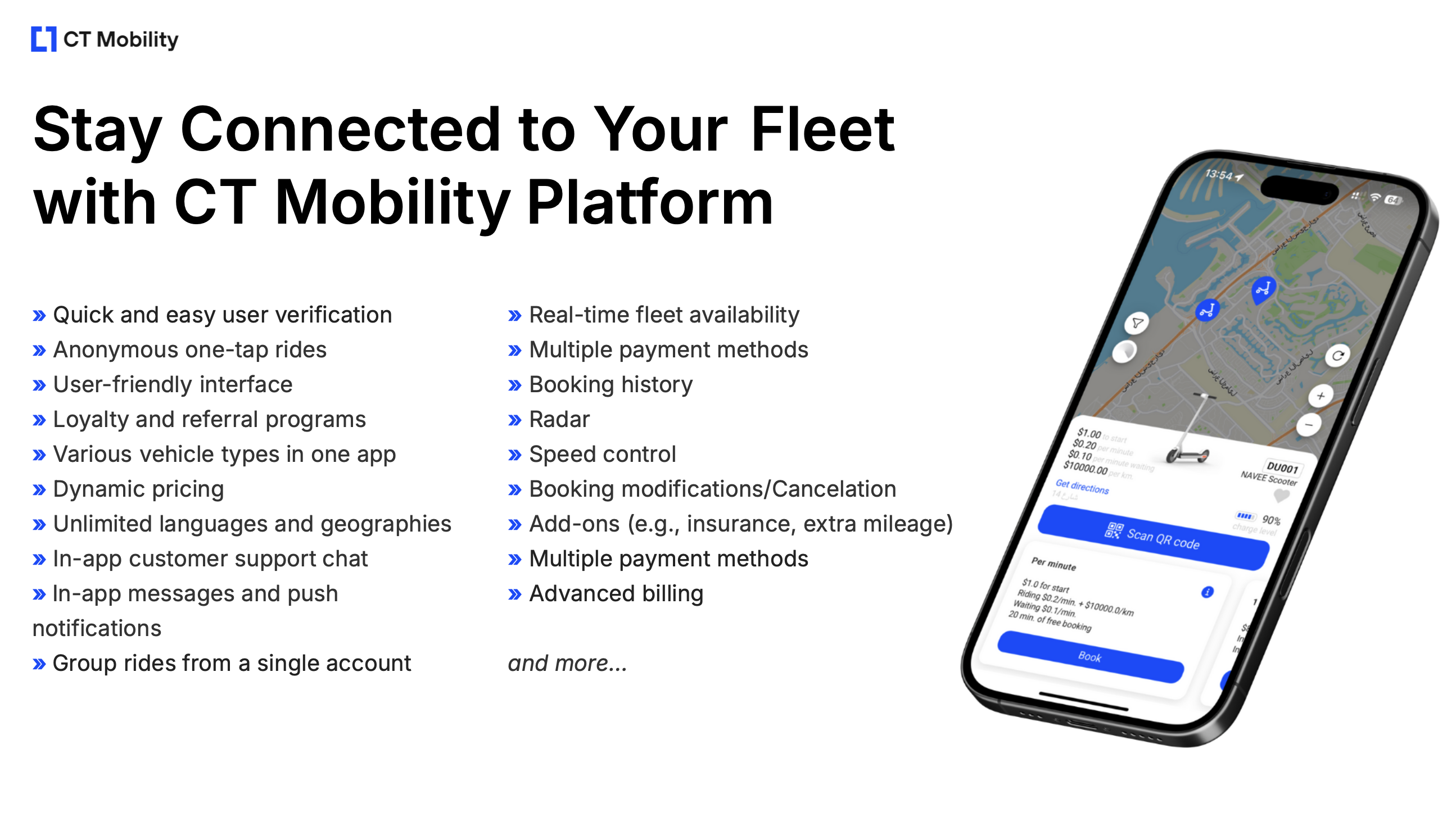
CT Mobility's e-scooter sharing software covers this list as a white-label platform. Riders scan a QR code and pay per minute, per ride or with a pass. You draw the zones on the map. Charging, rebalancing and repairs are planned as tasks in the fleet management app. If you later split the business between franchisees, technician access can be limited to each franchisee's own vehicles.
For the daily routine after launch, read how to manage a scooter sharing fleet with software. And if you'd rather ask a question than build a report ("Which scooters have open alarms right now?"), see AI scooter sharing software.
Costs to plan for
Prices differ by country and by year, so here is the list of lines for an e-scooter business plan. Fill it in with quotes from your own suppliers.
Before launch:
- Scooters, spare batteries and chargers, bought or leased
- IoT modules and SIM cards, if they aren't built into the scooter
- Permit or tender fees and company registration
- Depot or workshop fit-out, tools, a van or a cargo bike
- Software setup, branding of the app and the scooters
- Launch marketing and first-ride promotions
Every month:
- Field team: charging, moving scooters, repairs
- Rent and electricity for the depot
- Software subscription and mobile data for the IoT modules
- Payment processing, charged on every transaction
- Insurance and recurring city fees
- Spare parts, plus a reserve for vandalism and theft
- Customer support
- A reserve for replacing worn-out scooters
A worked example
The numbers below are made up to show the method. Take 100 scooters in a mid-sized city. On an average day 80 are on the street and charged, and the rest are in the workshop or waiting for a battery. Each available scooter does 3 rides a day, a ride lasts 12 minutes, and the price is €1 to unlock plus €0.20 a minute.
- Revenue per ride: 1 + 12 × 0.20 = €3.40
- Rides per day: 80 × 3 = 240
- Revenue per day: 240 × 3.40 = €816
- Revenue per 30-day month: €24,480, before payment fees and tax
Now change one input. At 2 rides per scooter the month brings €16,320, so each daily ride per available scooter is worth €8,160 a month. If the monthly lines in your budget add up to €20,000, this fleet breaks even at about 2.5 rides per available scooter per day (20,000 ÷ 8,160). Rides per scooter per day is the number to watch from the first week, next to the share of the fleet that is available to rent.
Run the same sum for your worst month. In a city with a cold winter or a very hot summer the rides drop and the monthly lines stay. For hourly or daily rental, replace rides with rentals per scooter per day and the average bill.
Mistakes we'd avoid
- Ordering scooters before the permit conversation. Fleet caps, parking rules and required equipment can change which model you need, or whether you can operate at all.
- Buying consumer scooters to save money on the pilot.
- Launching across the whole city at once. A small zone with enough scooters serves riders better than a large one where the nearest scooter is a ten-minute walk away.
- Leaving parking to chance. Decide where rides may end and what happens to a rider who ignores it before the city asks you.
- Planning revenue on 100% of the fleet when part of it is always charging or in repair.
- Leaving the low season out of the budget.
What to do this week
- Write down the model and the one area where you'd start.
- Book a meeting with the transport department or the site owner and send your questions in advance.
- Ask two suppliers for a quote on the same sharing-grade model, with spare batteries and parts.
- Fill in the cost lines and run the rides-per-scooter sum for a good month and a bad one.
Launch your vehicle sharing app in just 15 days with CT Mobility!
No setup fees. Unlimited features.
Free trial period.