A pool car is a company car that several employees share and book for work trips, instead of one person keeping it. Pool car management is everything around those cars: who may take which car and when, and a record of each trip with its driver, so a Salik charge or a new scratch can be traced to someone. CT Mobility runs it from a branded app: employees book a vehicle, unlock it with their phone, and you see who drove, where, for how long, the fuel level and photos of the car before and after every trip. Looking for the booking flow itself, with rules, approval and no-shows? See the vehicle booking system for employees.
Short answer: CT Mobility is pool car management software for UAE companies that share cars between employees: staff book a car in your branded app, pass a selfie check and unlock it by phone, and every trip is recorded with the driver, route, fuel and photos. From AED 50 per vehicle per month with tracking included; minimum AED 500 per month, hardware billed separately.
Last updated:
November 20, 2026
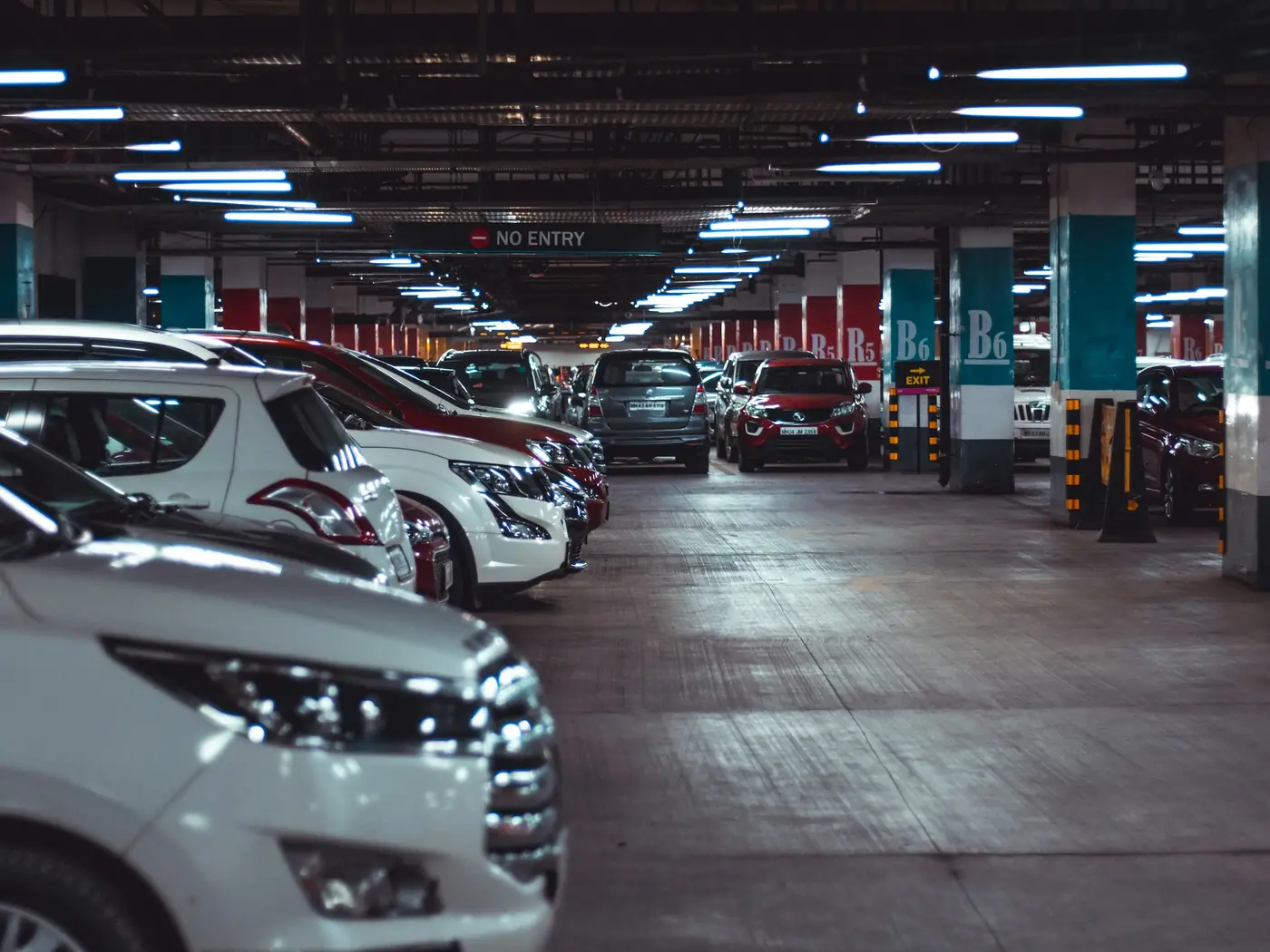
Nobody waits at reception for a key, and nobody keeps a booking spreadsheet next to the key box.
Inside the platform · demo data
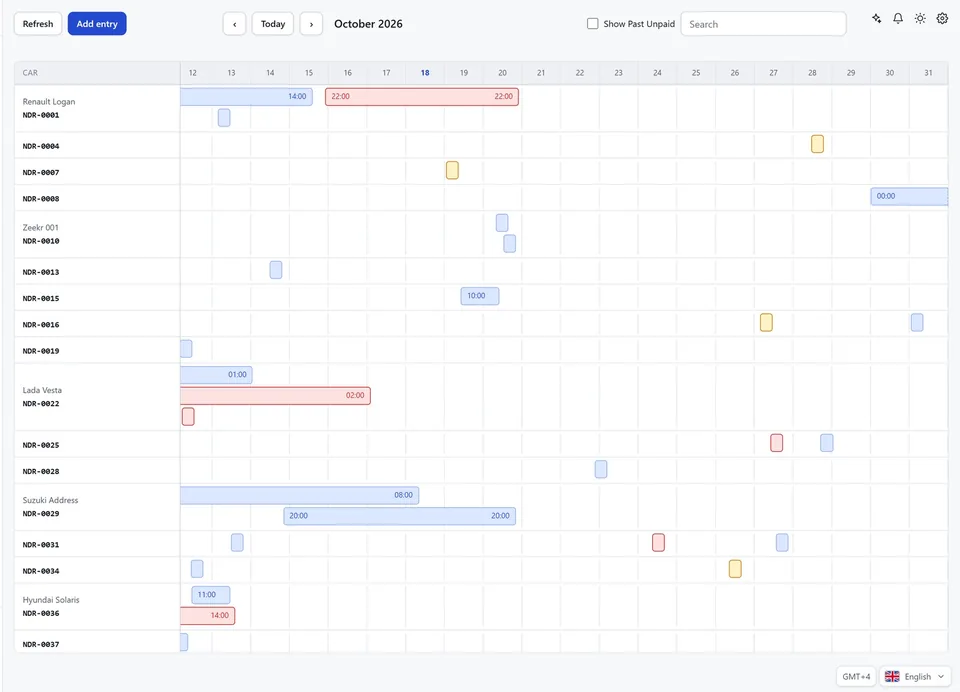
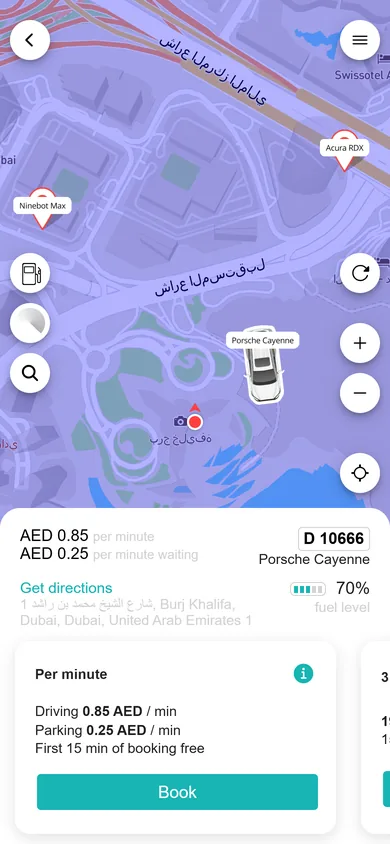
Bookings calendar. Cars as rows and reservations as bars, so free slots are visible at a glance. In the app, the car card shows the rate and fuel level, and the car is booked with one tap.
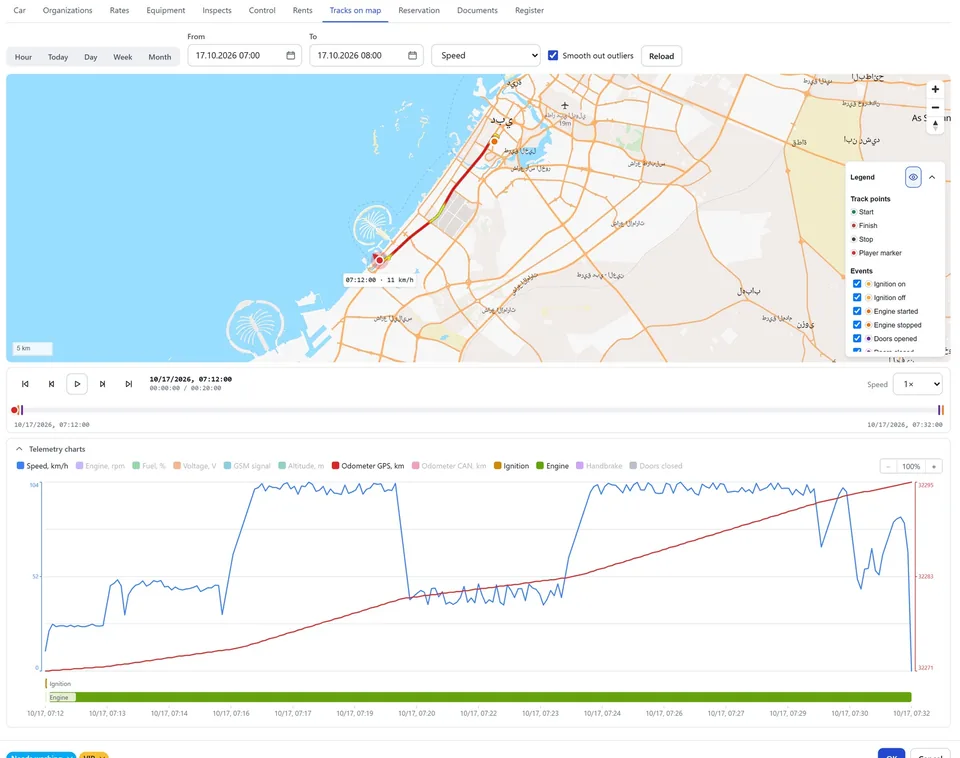
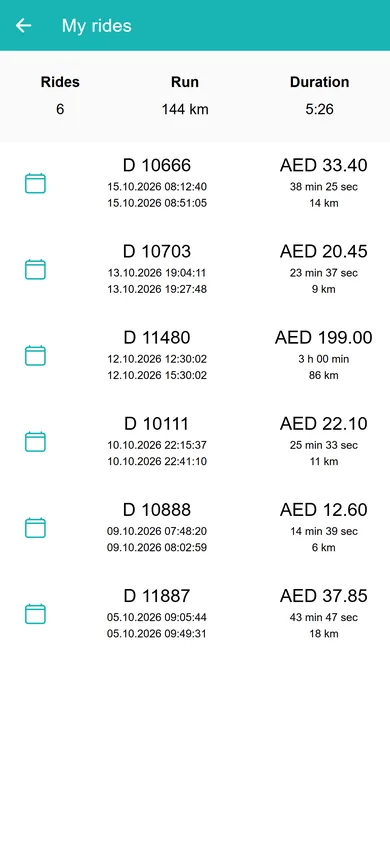
Trip telemetry. Any trip on the map, here from Dubai Marina to DIFC, with speed, ignition and engine charts along the route. Drivers keep their ride history with time, distance and cost in the app.
The two get mixed up. An assigned company car stays with one employee. A pool car (also written poolcar, or called a pool vehicle) belongs to no one in particular: whoever needs it books it, drives it for work and brings it back. Vans and pickups can be pool vehicles too.
| Pool car | Assigned company car | |
|---|---|---|
| Who drives it | Several employees, one booking at a time | One named employee |
| How it is handed out | Booked for a time slot, returned after the trip | Handed over once, stays with the driver |
| Who had it last Tuesday at 17:12? | Known only if every trip is booked or logged | The assigned driver, unless they lent it |
| What tends to go wrong | Cars standing idle, fines nobody owns, keys gone missing | Little visibility of how much the car is used for work |
If you run both, one vehicle management system should cover both. In CT Mobility assigned cars stay with their driver, shared cars are booked in the app, and the rules decide which employee may use which vehicle. Each vehicle has its trips, mileage, fuel level, alerts, photos and service tasks in one place, and each trip has a named driver.
Outside the UAE a set of shared cars is often called a motor pool; see motor pool management software.
Set permissions by employee, department, vehicle, day and time. Sales reps can see only city cars, technicians only vans, and night-shift staff only the vehicles assigned to their shift. Limits and rules can differ per company or department, with corporate billing through the B2B portal.
| Role | What they do in CT Mobility |
|---|---|
| Employee (driver) | Sees only the cars they may book, books a time slot, passes the selfie check, photographs the car, unlocks it by phone and returns it with photos |
| Fleet administrator | Adds cars and employees, sets the access rules and limits, sees every booking and trip on the map and in the dashboard |
| Department or team | Gets its own set of cars, days and hours through the rules, for example vans for technicians only |
| HR or finance | Uses the trip records to trace a fine or a toll to the employee who drove and to apply the company policy |
Rules are set once and checked on every booking, with optional monthly limits. The digital key works only for the booked time.
Every trip keeps who booked the vehicle, start and end time, route and mileage, trip duration, reported damage and technical issues, condition photos and driver comments. A selfie liveness check and an alertness check run before the trip starts. Harsh driving, speeding, towing and suspected theft generate alerts, and maintenance needs and low fuel are flagged early.
Made-up numbers, to show the method. An office in Business Bay shares 12 sedans between sales, finance and admin. The cars can be booked on weekdays from 8:00 to 17:00, and the month has 22 working days, so each car has 9 × 22 = 198 available hours and the pool has 2,376.
Utilisation (utilization, if you write it the US way) is booked hours divided by available hours. The month's trip records show this:
| Cars | Booked hours per car | Utilisation |
|---|---|---|
| 9 cars | 110 | 110 / 198 = 56% |
| 3 cars | 20 | 20 / 198 = 10% |
| All 12 | 1,050 in total | 1,050 / 2,376 = 44% |
What about the three quiet cars? Ask why before you hand them back. They might be the only 7-seaters, kept for a monthly site visit, or they might sit on a parking level nobody likes walking to. If neither is true, they're candidates to move to another office or to return when the lease ends. More on the formula in how to calculate fleet utilisation.
The same records settle the fine question. The Salik statement shows a crossing by car #7 on Tuesday at 17:12. In the trip history car #7 was booked from 16:40 to 18:05 by someone in sales, so the charge goes to that booking under your policy. The whole routine is on company car fines, Salik and Darb.
Which pool cars had no trips this week? Who had car #214 on Thursday afternoon? Ask in the control panel with the AI Data Assistant, or connect ChatGPT or Claude to your CT Mobility installation with Ask your fleet, the built-in MCP server that works under your own login and permissions, read-only by default and available to connect on request.
An office pool in Dubai pays Salik and Parkin, a pool in Abu Dhabi pays Darb and Mawaqif, and a car that leaves Sharjah for a meeting in Dubai can collect parking and toll charges in one afternoon. With a booking for every trip, each of these charges has an employee next to it. Companies with offices in several emirates run all their pool cars in one dashboard, with rules per office or department, and we install the telematics units in every emirate.
Local rules and costs: fleet management in Dubai and fleet management in Abu Dhabi.
Most UAE companies go from keys at reception to app-based pool cars in about 15 days from agreement to go-live. The steps:
Check these before you start:
| Included in AED 50 per vehicle / month | Billed separately |
|---|---|
| White-label iOS and Android app under your brand | Telematics hardware and installation |
| Fleet management platform and dashboards | M2M SIM cards and mobile data |
| Real-time GPS tracking and monitoring | SMS notification fees |
| Unlimited users, cloud hosting, software updates | |
| Technical support and onboarding |
No setup fee and no per-user charges. Minimum subscription AED 500 per month.
Pilot for UAE companies: we connect up to 2 of your vehicles with no subscription fee for 3 months, so you can judge the results on your own operations before any commitment. Only the hardware, installation and mobile data are paid. Go live in about 15 days.
CT Mobility Solutions F.Z.C. · E-Commerce Hub BC-8, Ajman Free Zone C1 Building, Ajman Free Zone, Ajman, United Arab Emirates
No. A telematics device is installed in your existing vehicles to enable keyless access and tracking.
Yes. A pilot for up to 2 vehicles with no subscription fee for 3 months is available; only the hardware, installation and mobile data are paid.
Each car needs a compatible telematics unit, and not every model supports every function. Drivers need a smartphone, access in underground car parks should be checked on site, and fines are traced through the trip history rather than imported. The minimum subscription is AED 500 per month.
We have repeatedly proven this in practice with dozens of launched projects and years of successful work. Ask our clients who have tried several IT solutions but still remain with us.




