ChatGPT and Claude can already help a fleet manager write, check and summarise. To answer questions about your own vehicles, trips and fines, they need a connection to your fleet data, and that is what MCP is for.
Short answer: A general AI chatbot helps with text and files you give it: policies, emails, spreadsheets. It does not know where your cars are or who drove them. To ask about live fleet data, the AI must connect to your fleet system, usually through an MCP server, under your own login and permissions, read-only by default and with every action confirmed and logged.
Last updated:
October 22, 2026

All of this works on text and files you provide. The chatbot does not see your fleet.
Ask a general chatbot “Which pool cars had no trips this week?” and it can only guess or ask you for a file. Exports help, but they are out of date the moment they are downloaded, they take time to prepare, and a spreadsheet pasted into a chat contains more data than the question needs. For questions about live vehicles, trips, payments and fines, the AI needs a direct, controlled connection to the system where that data lives.
MCP, the Model Context Protocol, is an open standard that lets AI tools such as ChatGPT and Claude work with other software. A fleet platform with an MCP server offers the AI a set of tools, for example “search trips” or “list vehicles with alarms”. When you ask a question, the AI client calls those tools on your behalf, under your login, and answers from the result.
Several telematics vendors have released ChatGPT or MCP connectors for their fleets. For car sharing, car rental and corporate pool cars, CT Mobility offers the same through Ask your fleet, the MCP server built into its platform.
Operator console · demo data
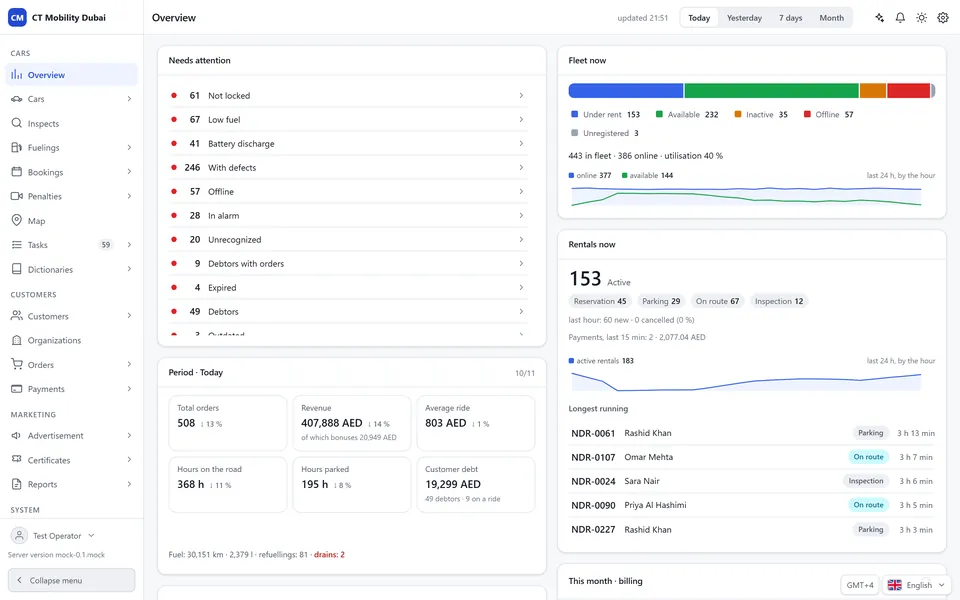
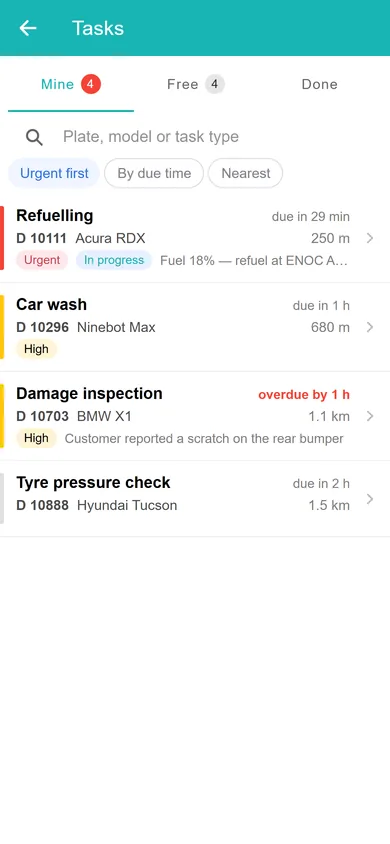
Fleet overview. Utilisation, active rentals, revenue in AED and the cars that need attention: the figures the assistant reads when you ask about your fleet. Technicians get a prioritised task list.
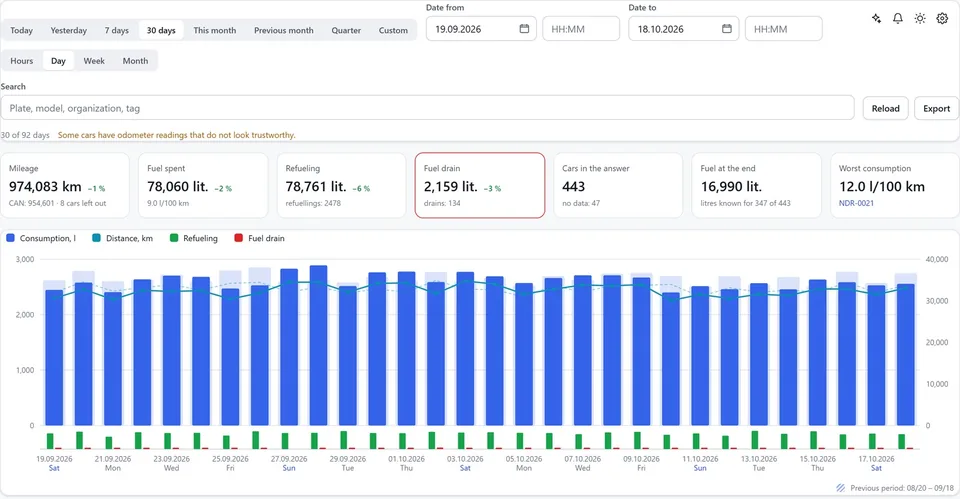
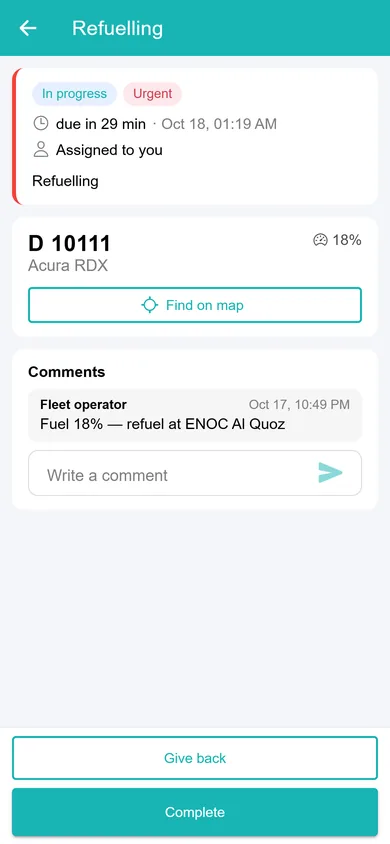
Fuel and mileage. Mileage, fuel spent, refuelling and suspected drains per day: the numbers behind questions about fuel costs. Cars low on fuel become refuelling tasks in the technician app.
Good questions name a time period, a vehicle or a group, and a result you can check.
CT Mobility offers two steps. The AI Data Assistant in the control panel answers questions about your data in plain language. Ask your fleet connects ChatGPT, Claude and other MCP clients to the platform under each employee’s own login: read-only by default, changes and commands only with permission and confirmation, every call in the audit log. It runs inside your CT Mobility installation and is available to connect on request.
For operators, see the AI car sharing platform and AI car rental software.
Pilot for UAE companies: we connect up to 2 of your vehicles with no subscription fee for 3 months, so you can judge the results on your own operations before any commitment. Only the hardware, installation and mobile data are paid. Go live in about 15 days.
CT Mobility Solutions F.Z.C. · E-Commerce Hub BC-8, Ajman Free Zone C1 Building, Ajman Free Zone, Ajman, United Arab Emirates
It answers questions that would otherwise need a report or a manual lookup, such as idle vehicles, who drove a car at a given time or unpaid fines by driver, and it helps with policies, emails and spreadsheets. Decisions stay with people.
Yes, for writing and analysing files you give it. To answer questions about live fleet data, ChatGPT needs a connection to your fleet system, for example through an MCP connector.
An AI that can call tools in your fleet system on your behalf: search trips, list alarms or prepare a task. A safe agent works within the employee’s permissions and asks for confirmation before any change.
A component of a fleet platform that exposes its data and actions to AI tools through the Model Context Protocol, so ChatGPT, Claude and other MCP clients can answer questions from the platform under the user’s login.
No. Telematics devices record positions, ignition, speed and other vehicle data. AI can help you ask questions about that data, but tracking itself is not AI.
It can be, if the connection uses each employee’s own login and permissions, is read-only by default, asks for confirmation before changes and keeps an audit log, and if your AI provider’s terms fit your data policy.
Mostly for answers and reports in plain language, and for preparing routine actions such as technician tasks. Be careful with broader claims, such as prediction or autonomous decisions, and ask the vendor what exactly the AI does.
We have repeatedly proven this in practice with dozens of launched projects and years of successful work. Ask our clients who have tried several IT solutions but still remain with us.




