“AI” now appears in almost every fleet software brochure. Some of it is real machine learning, some is a rule with a new name, and some is a chat assistant on top of your data. This overview sorts the main uses of AI in fleets by what they do, what they need and where they help.
Short answer: AI in fleet management today mostly means five things: video analysis in AI dash cams, predictive maintenance from vehicle data, route and dispatch optimisation, automated damage inspection in rental, and AI assistants that answer questions about fleet data in plain language. Each needs different data and hardware. Many “smart” features are rules, not AI, and that is fine as long as the vendor says so.
Last updated:
October 22, 2026
| Use | What it does | What it needs |
|---|---|---|
| AI dash cams and video telematics | Detects phone use, tailgating or fatigue on camera and alerts the driver or the manager | Cameras in every vehicle, video storage, a clear policy for drivers |
| Predictive maintenance | Estimates when a part may fail from fault codes, mileage and sensor data | Rich engine data from the vehicle and a model trained on many similar vehicles |
| Route and dispatch optimisation | Plans routes and assigns jobs to vehicles and drivers | Jobs, addresses, time windows and live vehicle positions |
| Automated damage inspection | Compares photos or scans of a car at pickup and return to find new damage | Scanning gates or guided photos and a review process for disputed charges |
| AI assistants and agents | Answer questions about fleet data in plain language and prepare actions | A connection to the fleet system, permissions and an audit log |
Camera-based systems are the most visible AI in trucking and delivery fleets. A model watches the road and the cabin and flags risky events, so coaching can focus on real incidents. The trade-offs are hardware in every vehicle, video storage and driver privacy, which need a written policy and, in many countries, legal review.
Predictive maintenance tries to fix a vehicle before it breaks, using fault codes, mileage, engine hours and sensor readings. It works best on large, uniform fleets with rich engine data. For most company fleets the first step is simpler: service reminders by real mileage and alerts for faults, which are rules rather than predictions.
Optimisation algorithms plan delivery routes, assign jobs and, in sharing services, suggest where cars should be moved to meet demand. They need good job and demand data, and they pay off where there are many stops or many vehicles to place each day.
Some rental companies use scanners or guided photos to detect new damage automatically. It is also the most disputed use of AI in rental, because customers contest charges they did not expect. Whatever the technology, a person should review the evidence before a customer is charged.
The newest use is generative AI. Instead of building a report, a manager asks “Which pool cars had no trips this week?” or “Show unpaid fines for September by driver” and gets the answer from the fleet system. Through MCP, the Model Context Protocol, tools such as ChatGPT and Claude can work with a fleet platform directly, under the user’s login. The practical how-to is in our guide on how fleet managers can use ChatGPT, Claude and MCP.
Operator console · demo data
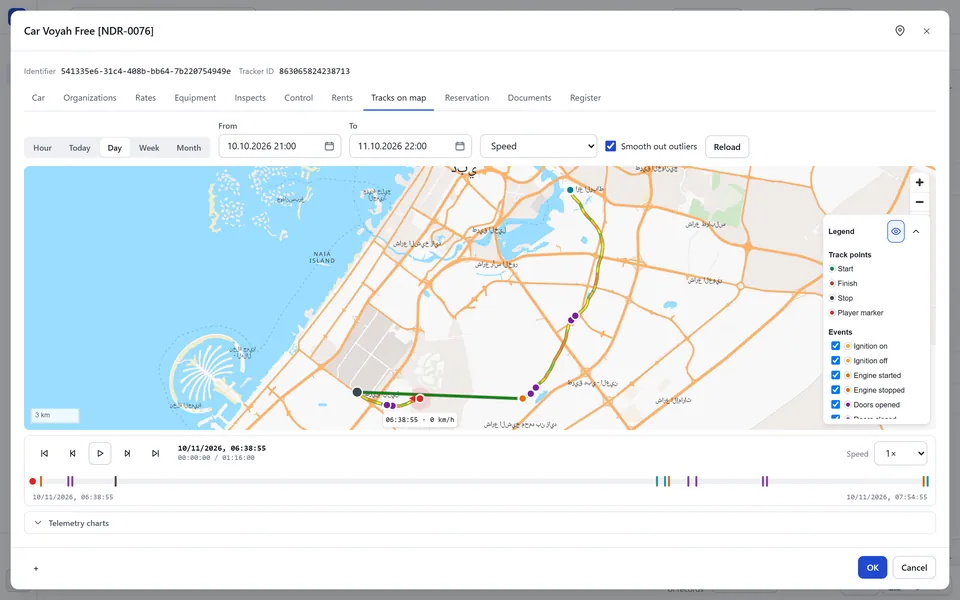
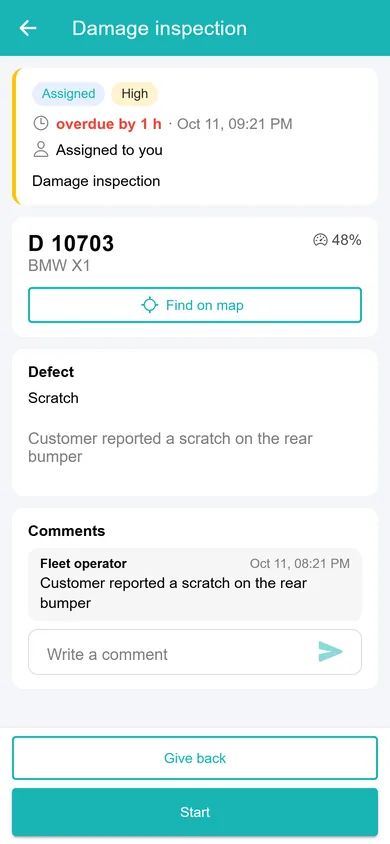
Trips and events. Every trip is stored with ignition, door and speed events, so a question like “who drove this car on Tuesday?” has a recorded answer. Damage reports become tasks for the team.
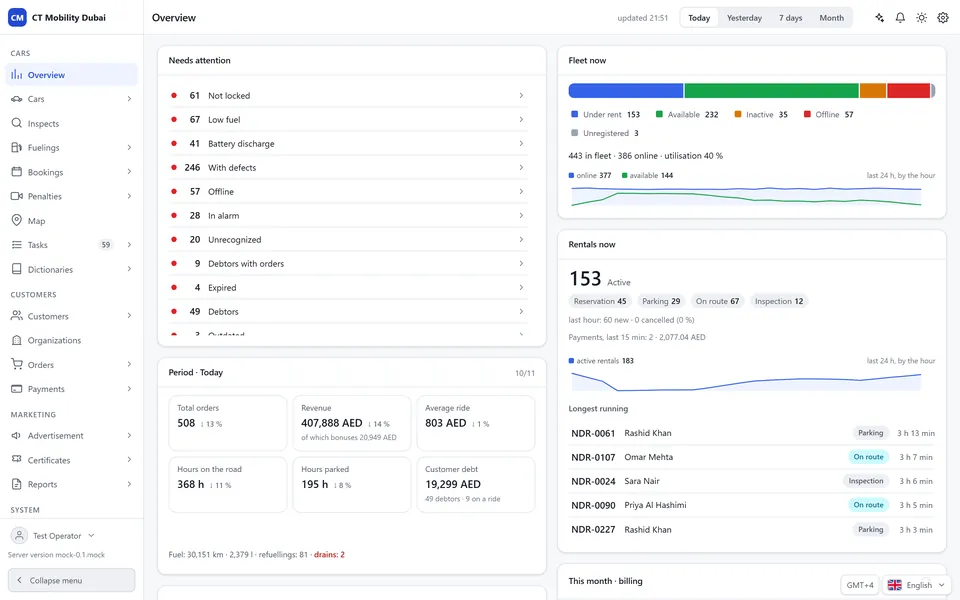
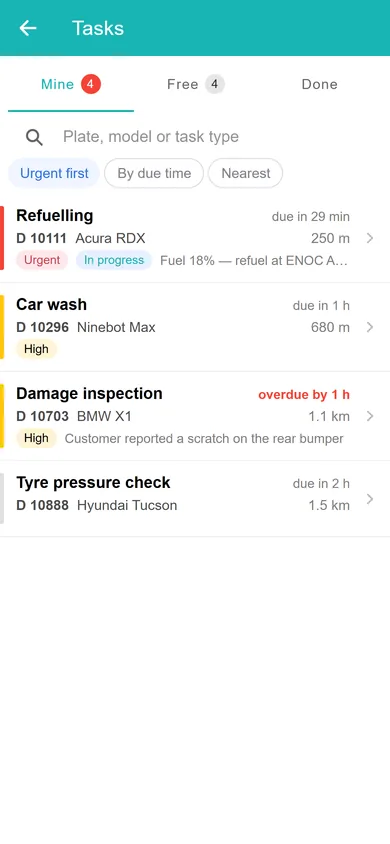
Fleet overview. Utilisation, active rentals, revenue in AED and the cars that need attention: the figures the assistant reads when you ask about your fleet. Technicians get a prioritised task list.
CT Mobility builds software for car sharing, car rental and company fleets. Its AI is the assistant kind:
CT Mobility does not offer AI dash cams, AI damage scanning, predictive maintenance, AI pricing or demand forecasting. Its automation, such as alerts that become tasks, zones on a schedule and rule-based discounts, is configured by you. For operators, see the AI car sharing platform and AI car rental software.
CT Mobility Solutions F.Z.C. · E-Commerce Hub BC-8, Ajman Free Zone C1 Building, Ajman Free Zone, Ajman, United Arab Emirates
The use of machine learning and AI assistants in fleet work: video analysis in dash cams, predictive maintenance, route optimisation, automated damage inspection and assistants that answer questions about fleet data in plain language.
It depends on the problem. Safety programmes use AI dash cams, large uniform fleets use predictive maintenance, delivery fleets use route optimisation, and managers who need quick answers use an AI assistant connected to their fleet system.
No. AI answers questions, finds patterns and prepares actions, but decisions about drivers, vehicles, money and safety stay with people.
It can be, when a model predicts failures from engine and sensor data. Many products call mileage-based service reminders “predictive”; those are useful rules, not predictions.
Start with questions you already answer by hand, such as idle vehicles or fines by driver, and use an AI assistant connected to your fleet data, with your own login, read-only access and an audit log.
No. CT Mobility offers the AI Data Assistant in the control panel and Ask your fleet, an MCP server for ChatGPT, Claude and other MCP clients. It does not offer AI cameras, damage scanning, predictive maintenance, AI pricing or forecasting.
We have repeatedly proven this in practice with dozens of launched projects and years of successful work. Ask our clients who have tried several IT solutions but still remain with us.




