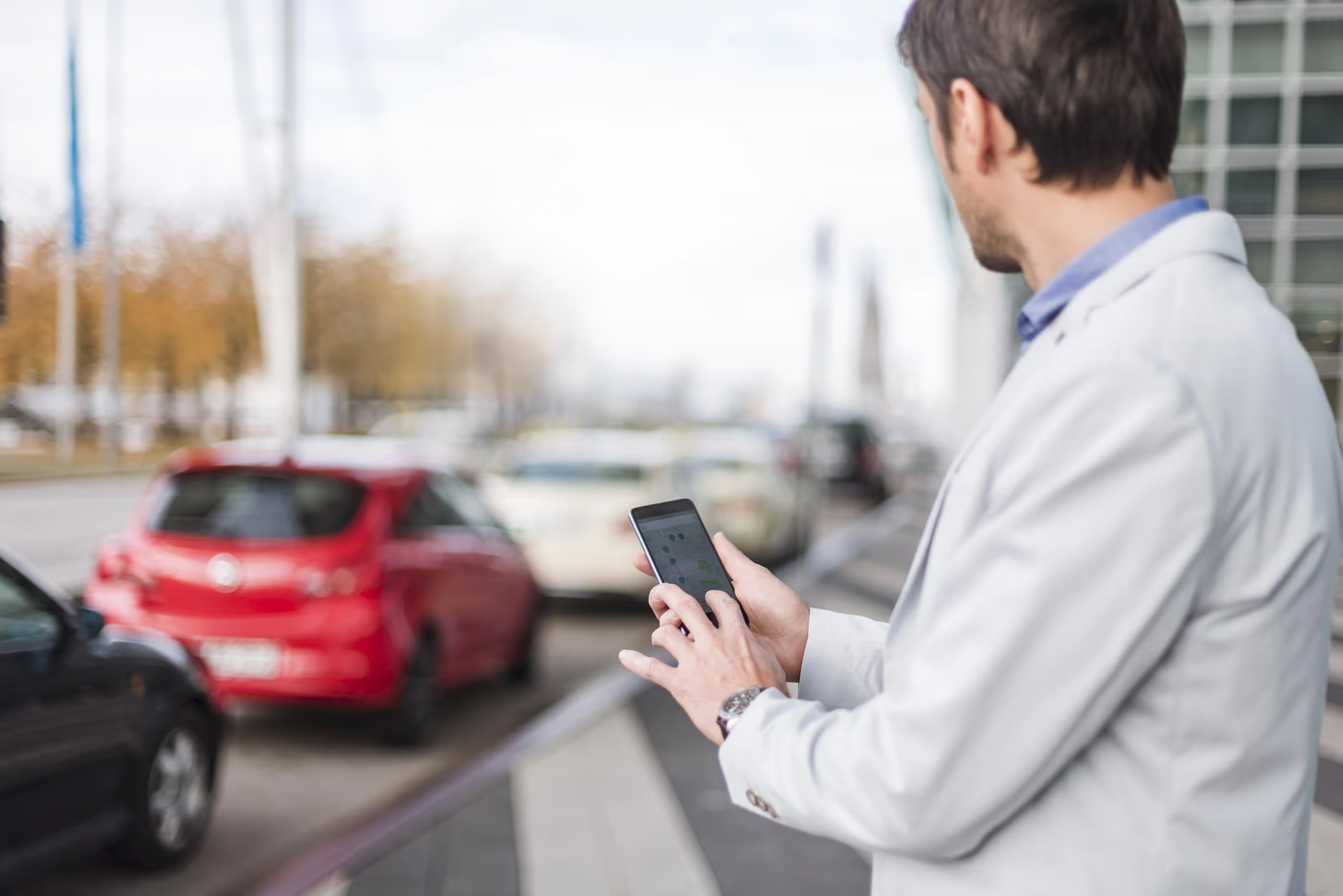
One-way carsharing is a carsharing trip that ends somewhere other than where it started. You find a car in the app, open it with your phone, drive across town and leave it inside the operator's zone or at another station, then end the rental in the app. You pay for the minutes, hours or days you used, and the car stays there for the next customer.
Carsharing itself means short-term use of a shared car that you book and open through an app, without a rental desk. In the classic round-trip version the car goes back to the spot where you took it. One-way drops that rule. Customers like it for exactly that reason, and it's also the reason one-way costs the operator more to run. We build software for operators, so the second half of this page is about their side.
The spelling varies: one-way carsharing, one way car sharing and carsharing one way are the same model. In German it's One-Way-Carsharing, in Portuguese carsharing one-way or carro compartilhado só de ida.
One-way, round-trip and free-floating compared
One-way describes where a trip ends. Free-floating and station-based describe where the cars stand. So a one-way service can be free-floating (park on any legal spot inside the zone) or station-based (take the car at station A, return it at station B).
| Model | Where the trip ends | How people book | Work for the operator |
|---|---|---|---|
| Round-trip, station-based | The same station | Mostly ahead, by the hour or day | Low: cars come back home |
| One-way, station-based | Any station in the network | Ahead or on the spot | Medium: some stations fill up, others run empty |
| One-way, free-floating | Any allowed spot inside the zone | On the spot, often by the minute | Highest: cars drift to wherever trips end |
Our free-floating vehicle sharing guide covers the zone-based model in more depth. If you're still choosing a model for a new service, carsharing formats compared goes through station-based, free-floating, corporate and hybrid setups.
How a one-way trip works
- Open the operator's app and pick a car on the map.
- Book it and open it with your phone. No key handover, no office.
- Drive. The meter runs per minute, hour or day, depending on the tariff.
- Park inside the area where trips are allowed to end. The app shows it on the map.
- End the rental in the app. The system checks where the car is: outside the allowed area the trip won't end, or the operator charges an extra fee for ending it there.
For the customer that's the whole appeal. A ride to the station, home after a late dinner, to a meeting on the other side of the city, with no return leg to plan.
The cost operators plan for: moving cars back
One-way trips don't spread cars evenly. Morning trips can pile them up in the business district, evening trips pull them out to residential areas, and a few end up at the edge of the zone where nobody books them for half a day. Someone has to drive those cars back. That job is called relocation or rebalancing, and it's the running cost one-way adds on top of round-trip.
A simple way to keep an eye on it:
Relocation cost per trip = (cars moved per day × cost of one move) ÷ trips per day
Here is an example with illustrative numbers. A service runs 40 cars and makes 110 trips a day. Each morning 12 cars are standing where they haven't been booked since the evening. A field worker needs about 35 minutes per move, including getting to the car, which at €25 an hour of staff cost is roughly €15 a move.
| Item | Value |
|---|---|
| Cars moved per day | 12 |
| Cost of one move | €15 |
| Relocation cost per day | €180 |
| Trips per day | 110 |
| Relocation cost per trip | €1.64 |
| Share of a €12 average trip | about 14% |
Count it weekly. If the number per trip keeps climbing, either the zone is too big for the fleet or one district keeps swallowing cars.
Ways to bring the number down
- Draw rental completion zones so trips can't end in places where cars would sit idle.
- Let customers end outside the zone for an extra fee that grows with the distance from it. The fee pays for part of the move.
- Credit a bonus to customers who leave the car in an area where you need it, for example next to a train station before the morning peak.
- Give cars that nobody books an automatic discount, so the next customer moves the car for you.
- Send the cars that are left as tasks to the field team, grouped by area and combined with cleaning and refuelling on the same run.
Where one-way works and where it struggles
It fits dense city centres with short trips, where a car left anywhere in the zone gets picked up again within a few hours. It gets harder at the edges: suburbs, trips that leave the city, airports with paid parking. For an airport a paid completion zone helps, because the customer's fee covers the parking or the drive back.
Some operators mix the two. A free-floating zone in the centre, a handful of stations in the suburbs, and one-way trips allowed between them.
Running one-way carsharing on CT Mobility
Our car sharing software runs free-floating zones, fixed stations, round-trip or one-way rentals on one platform, with per-minute, hourly and daily tariffs. You draw zones on the map, choose which client group sees each zone and switch zones on and off on a schedule. The operator gets an alert when a car leaves its area, and technicians work through their tasks in a separate app.
Planning a one-way service? Book a demo and bring a rough zone map and fleet size. That's enough for a first conversation.
Launch your vehicle sharing app in just 15 days with CT Mobility!
No setup fees. Unlimited features.
Free trial period.