Sunday, 11:30. A message lands in the support chat of a Dubai car sharing service: “You took AED 189 from my card for one evening in town. The app said 0.90 a minute. And where’s the AED 25 my friend’s invite was supposed to give me?” The trip ran from Friday 23:18 to Saturday 00:58, across midnight, Marina to Downtown and back to JLT. Here’s how we’d answer it with an AI assistant connected to the platform. The service, the customer and every amount below are a demo, made up for the example.
Short answer: Put the rental, its tariff periods, every card operation (holds as well as charges), tolls added to the rental and the bonus operations on one timeline. Explain the bill line by line from that: which minutes were driving and which were parking, which rate applied before and after midnight, what was a hold and when it was released, and whether the bonus arrived before or after the rental was charged. Any goodwill credit is a separate decision, made and confirmed by a person.
Last updated:
November 12, 2026

Without help, the agent would open four screens: the rental, the tariff it ran on, the customer’s payments and the bonus history. Then they’d line up times by hand, in a chat window, while the customer waits. Each screen is right on its own. The trouble is in the gaps between them, and in a clock that changed tariff at midnight.
The agent has ChatGPT connected to the platform and asks for everything at once:
Support agent: customer says 189 aed for fridays trip and a missing 25 aed invite bonus. show the rental, tariff, every card operation incl holds, tolls and bonus operations with times. dubai time. dont change anything
ChatGPT: One rental, Friday 23:18 to Saturday 00:58, 100 minutes. The tariff on it has an evening driving rate until 00:00 and a night rate after. No promo code or discount was applied.
| Time | Line | Minutes | AED per min | AED |
|---|---|---|---|---|
| 23:18–23:52 | Driving, evening rate | 34 | 1.10 | 37.40 |
| 23:52–00:31 | Parking, rental still running | 39 | 0.50 | 19.50 |
| 00:31–00:58 | Driving, night rate from 00:00 | 27 | 0.90 | 24.30 |
| Rental total | 100 | 81.20 |
| When | Operation | AED | Status |
|---|---|---|---|
| Fri 23:18 | Hold at the start of the rental | 100.00 | Released Sat 00:59 |
| Sat 00:59 | Rental charge | 81.20 | Paid |
| Sat 01:12 | Invite bonus credited to the balance | +25.00 | Balance 25.00, unused |
| Sun 09:40 | Salik, 2 crossings matched to this rental (23:41, 00:37) | 8.00 | Paid |
ChatGPT: 189.20 is the three card lines added together, including the hold. Charged and kept: AED 89.20. I can’t see the customer’s banking app or what the price screen showed them on Friday.
Keep that last line in mind. The data shows what the platform recorded; the customer’s bank list and their memory of the app are things the agent has to ask about.
Operator console · demo data
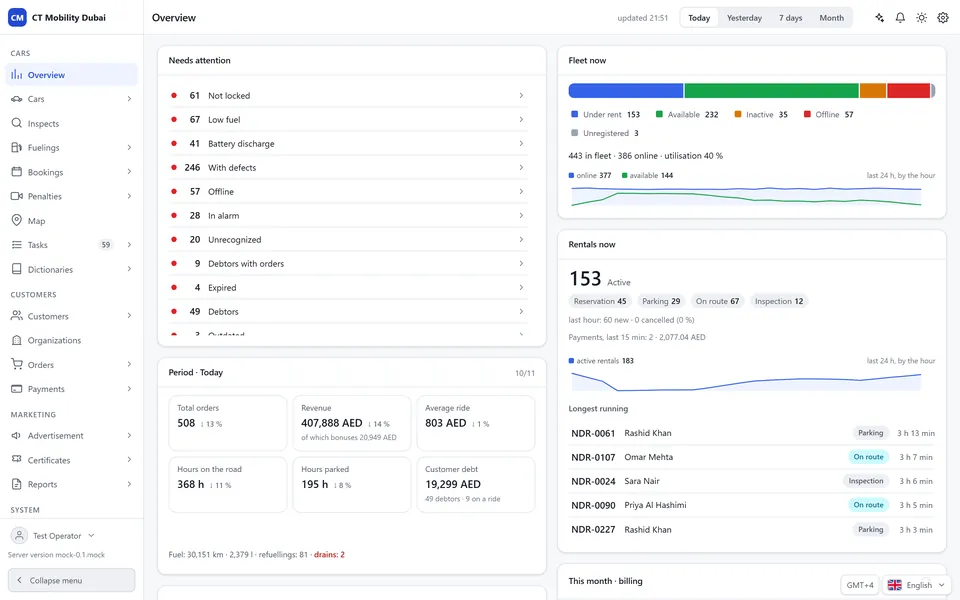
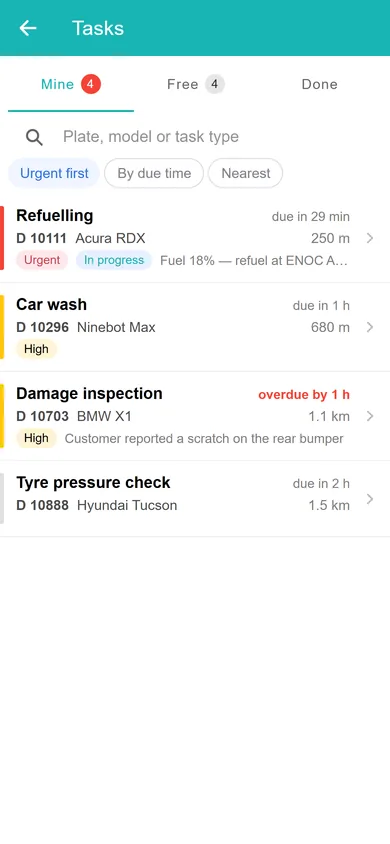
Fleet overview. Utilisation, active rentals, revenue in AED and the cars that need attention: the figures the assistant reads when you ask about your fleet. Technicians get a prioritised task list.
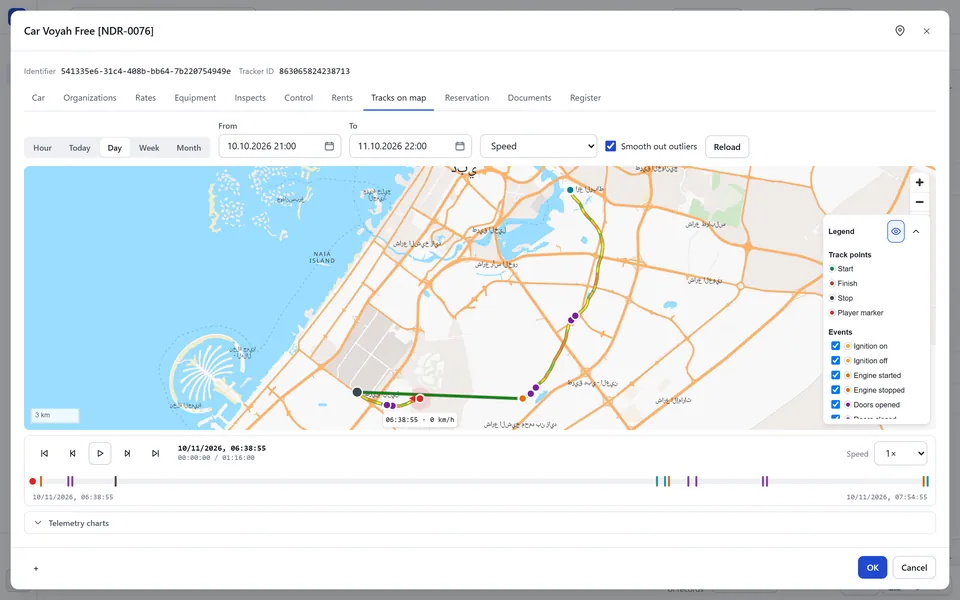
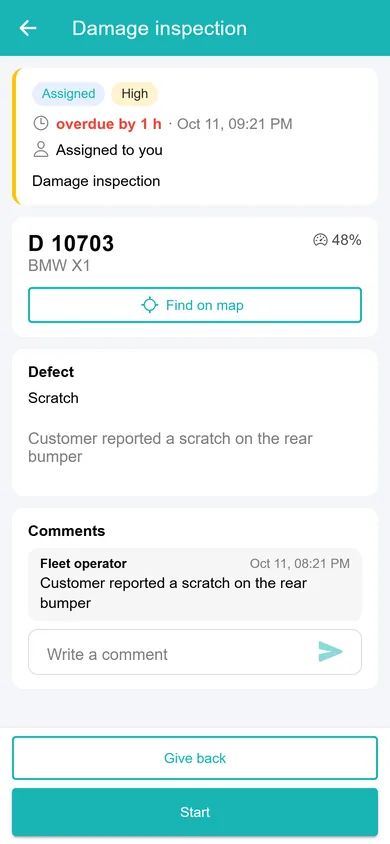
Trips and events. Every trip is stored with ignition, door and speed events, so a question like “who drove this car on Tuesday?” has a recorded answer. Damage reports become tasks for the team.
The customer’s own sum is easy to rebuild: 100 minutes at 0.90 is AED 90, minus the AED 25 bonus, makes 65. Here’s where each piece of the real bill comes from.
Start with the hold. AED 100 was blocked on the card at the start and released at 00:59, the minute the rental was paid. A banking app may keep showing a released hold for a while, and how long is up to the bank. It looks like a second charge, and it’s the biggest part of the “189”.
Then the rate. The 0.90 the customer remembers is the night rate. The first 34 minutes ran before midnight at 1.10. Maybe they checked the price on the way back, after 00:00. That’s a guess, and it’s easy to ask. In return, the 39 minutes parked near Dubai Mall cost 0.50 a minute, so the rental came to 81.20, cheaper than the 90 they expected.
Salik: two tolls on the trip, AED 8, charged on Sunday morning. Under this demo operator’s terms tolls are passed on to the customer; yours may handle them differently.
And the bonus, which the customer is right to ask about.
Support agent: why didnt the 25 apply
ChatGPT: The rental was charged at 00:59 with a bonus balance of 0. The invite bonus was credited at 01:12, 13 minutes later, and it’s still on the balance. The records show when it was credited, not why it came at that time.
So the bonus isn’t lost; it arrived after the bill. Put together: 65, plus the 25 that wasn’t used, plus 8 of Salik, minus the 8.80 the parking minutes saved, gives 89.20. Can your agent say that in two lines? Then the reply nearly writes itself.
The assistant drafts the answer; the agent edits it and sends it once the goodwill bonus below is saved:
Thanks for writing, and sorry for the confusion. Your card shows three lines. AED 100 was a temporary hold at the start of the trip; we released it at 00:59 on Saturday and your bank will drop it from the list. AED 81.20 is the trip: 34 minutes of driving at the evening rate, 39 minutes parked at AED 0.50 a minute and 27 minutes at the night rate after midnight. AED 8 is two Salik tolls from the trip. Your AED 25 invite bonus arrived at 01:12, just after the trip was paid, so it’s on your balance for the next one. We’ve added AED 10 for the trouble.
That last sentence is a decision, and it belongs to the support lead under your goodwill policy. If your installation lets support credit bonuses and the agent allowed changes when connecting, the assistant can prepare it:
Support agent: add a 10 aed goodwill bonus to this customer, reason “charge query, 6 nov rental”. show first
ChatGPT: Preview, nothing saved yet: bonus balance AED 25.00 → 35.00, reason “charge query, 6 nov rental”.
Support agent: confirm
ChatGPT: Saved. Read back: bonus balance AED 35.00. The change is in the audit log under your name.
A bonus is credit for future trips. If the customer wants money back on the card, that’s a refund, and it goes through your usual payment process with a person deciding it. The assistant can put the evidence in front of whoever does that; it doesn’t move money.
On control: Ask your fleet, the MCP server built into CT Mobility, works under each employee’s own login and permissions and is read-only by default. Changes work only if the employee allowed them when connecting, each one waits for a confirmation like the one above, and every call goes into the audit log. We enable it per installation, on request.
One bill at the support desk is the small version of a question finance asks about a whole month; for that one, see car rental revenue reconciliation. Rental desks get the same hold question at return; here’s our handover guide, from photos to the deposit.
CT Mobility Solutions F.Z.C. · E-Commerce Hub BC-8, Ajman Free Zone C1 Building, Ajman Free Zone, Ajman, United Arab Emirates
No. It reads payments, holds and their status as your CT Mobility installation records them from your payment provider. What the customer’s banking app shows, and how long a released hold stays visible there, is up to their bank.
There’s no public price. We enable it per CT Mobility installation on request, so the quickest way to find out is to book a demo from the Ask your fleet page and ask about your fleet.
We have repeatedly proven this in practice with dozens of launched projects and years of successful work. Ask our clients who have tried several IT solutions but still remain with us.




