Friday, 22:40, the Terminal 3 car park at DXB. A driver from a small Dubai rent-a-car hands a white mid-size SUV to a customer who flies home on Sunday. At 01:50 on Sunday the same customer leaves the car in a hotel car park in Business Bay and the key with the concierge. Whether the conversation about a scratch on the rear bumper takes five minutes or five days depends on what happened in that airport car park on Friday night. The company, the car and every number in this guide are made up for the example.
Short answer: Photograph the car in the same order at check-out and at return, with the time on every photo: corners and sides, wheels, glass, then one dashboard shot with the odometer and fuel gauge lit, then the interior and the boot. Mark existing damage on a diagram the customer accepts before the keys change hands. Settle a scratch dispute by putting the two photo sets side by side, and release the deposit by a rule you wrote down in advance, keeping in mind that tolls and fines reach you after the car is back.
Last updated:
November 12, 2026
Airport delivery is the hardest check-out you’ll do. It’s dark, the customer has just come off a long flight and wants to leave, and the driver has a taxi back to catch. That’s why the routine has to be identical every time and short enough for ten minutes under car park lights. Here’s the order we’d use, walking clockwise from the driver’s front corner:
| # | Photo | Why |
|---|---|---|
| 1 | Front left corner, wide, plate visible | Opens the set with the plate and the time |
| 2–8 | Left side, rear left corner, rear with plate, rear right corner, right side, front right corner, front with plate | The whole body in overlapping frames |
| 9 | All four wheels, close | Rims scrape easily on car park kerbs |
| 10 | Windscreen from inside, against the light | Chips show up this way |
| 11 | Dashboard with the ignition on | Odometer and fuel gauge in one frame |
| 12 | Front seats, rear seats, boot | Stains, sand, left items, the spare wheel |
| 13 | Each existing mark, close, with a key next to it | Size and exact position |
In the example the set has 31 photos, timed 22:41 to 22:52. The odometer reads 41,210 km and the tank is full. The driver marks two things on the damage map: a scuff under the right headlight and a small chip low on the windscreen. The customer looks at both, signs, and the AED 1,500 deposit hold goes on the card.
A word on time. A photo is only useful in a dispute if everyone trusts when it was taken. Photos taken in a rental app carry the time they were recorded; photos forwarded through a messenger can lose their original date. If drivers still use their own phones, check that the clocks are right.
In summer add one step: start the engine and let the AC run while you shoot the interior. If cooling is weak, you’d rather find out in the car park than get the call from Sheikh Zayed Road at noon.
The customer’s flight leaves at 05:00, so the car goes back to the hotel on Sunday night. Before a return like that, ask the customer for a short photo set: four corners, the dashboard and the bay number. Here they arrive at 01:48–01:53. The odometer shows 41,786 km and the fuel gauge sits at five-eighths. The car park is on level B2 and the photos are dark.
A driver picks the car up at 09:15. From 01:53 to 09:15 it stood in a public car park and nobody was looking after it. Who carries those hours is a business decision. Put it in your rental terms before the first after-hours return.
With a keyless car there’s no concierge in the story at all. The customer locks the car with the phone, and that lock is the return time.
The driver’s full check-in set at 09:15 shows a scratch of about 6 cm on the rear right corner. It isn’t on the damage map. The customer, back home, replies that it was there on Friday.
Before you answer, lay the photos side by side:
| Rear right corner | Time | What it shows |
|---|---|---|
| Check-out, photo 5 | Fri 22:46 | No scratch visible, but the panel reflects the car park lights |
| Customer’s return photo | Sun 01:51 | Too dark to tell either way |
| Driver’s check-in | Sun 09:15 | Scratch clearly visible |
That evidence is weaker than it feels. The scratch probably wasn’t visible at 22:46, a reflection could hide a fine mark, and seven hours in a hotel car park sit between the last two photos. Did the customer do it, or a neighbour’s door? The photos don’t say.
We’d send the customer the three photos with their times, calmly and without accusing anyone, and ask for the original files of their 01:51 photo. Then you decide under your terms. Charging on evidence this thin can cost you a customer and a review over a small repair. What you can charge, and how you prove it, comes from your rental agreement and UAE law, and this guide doesn’t replace either.
The fix belongs on Friday: shoot the rear corners from two angles, one with flash, and make the after-hours return set include them.
Inside the platform · demo data
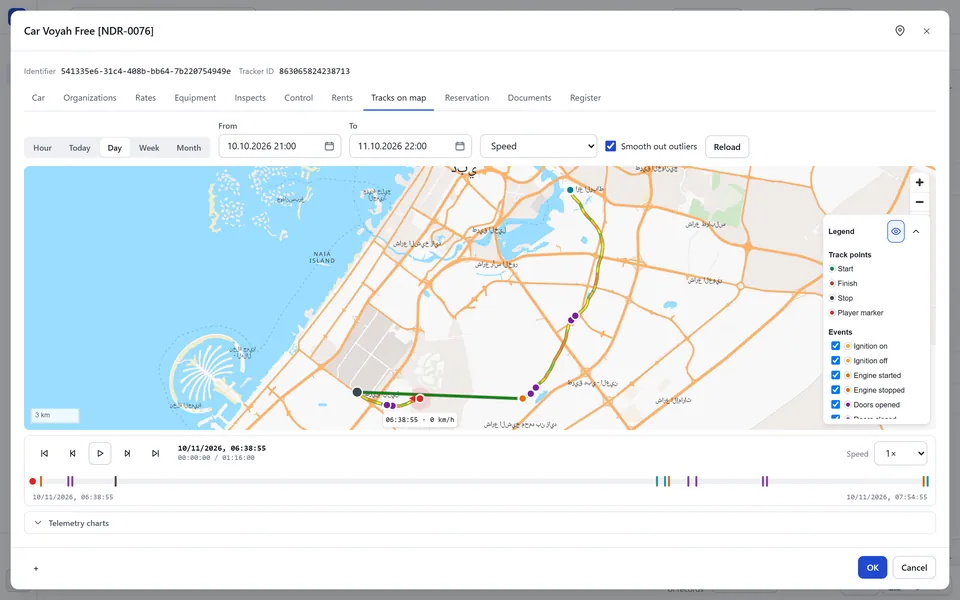
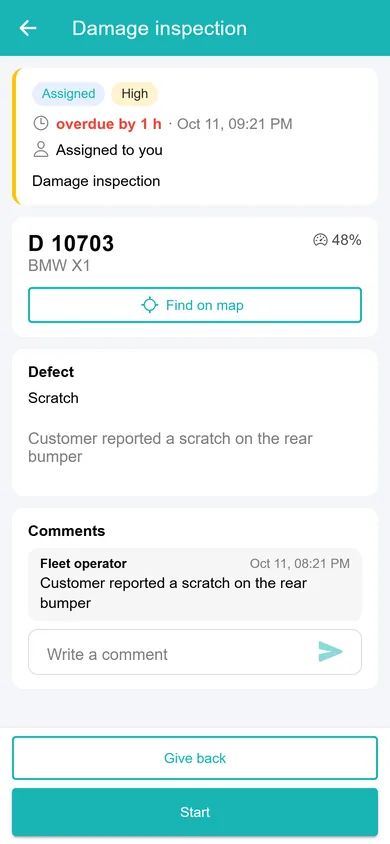
Trip history. Replay any trip with ignition, door and speed events to see exactly who drove and how. Damage reported by a customer becomes a task for your team.
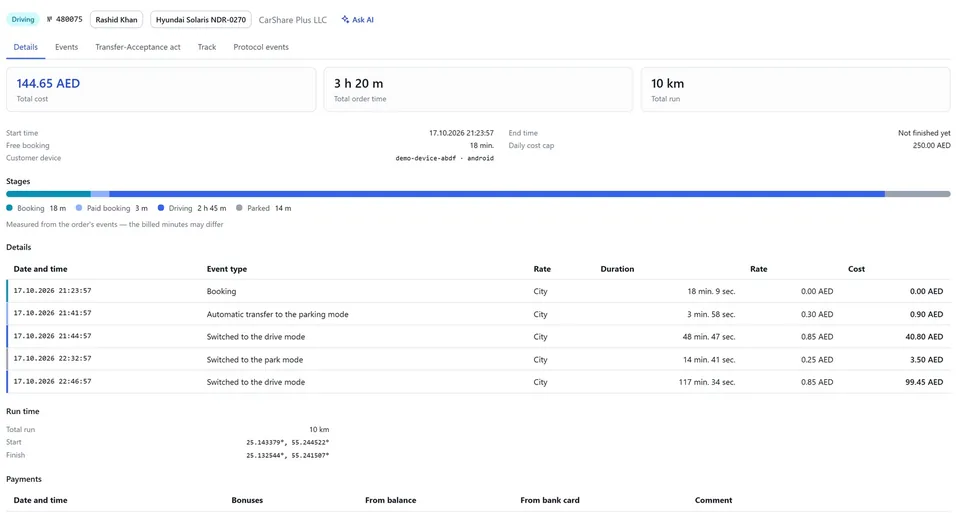
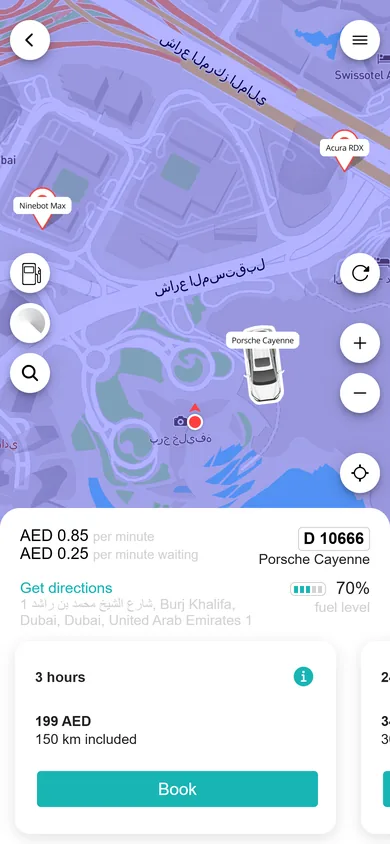
Who had the car. Each rental record shows the driver, the car, the time, the distance, the billing lines in AED and the start and finish points. In the app, customers can choose packages such as 3 hours with 150 km included.
Fuel and kilometres are the easy part when the dashboard photo exists at both ends. Full out, five-eighths back: the refuelling charge in your tariff. 576 km on a package with 500 included: 76 extra kilometres.
The deposit is harder, because some charges haven’t arrived yet. Salik tolls and traffic fines are registered to the vehicle’s owner, which for a rental car is you, and they reach you after the trip. Our guide to Salik and Darb covers how tolls work; for fines, look the plate up in the RTA’s Fines Inquiry and Payment service. Every toll and fine carries a plate and a timestamp, so the question is always which rental covered that minute.
A card hold also doesn’t last forever: your payment provider and the customer’s bank decide how long it stays valid. Ask your provider for that number, then pick a rule. Either release the hold on return minus the known charges and bill later tolls to the card under your terms, or keep it for a fixed number of days and release it the morning that ends. Either works, as long as the desk and finance use the same one. Holds also confuse revenue reports, which is a story of its own: how card holds and deposits show up in a revenue reconciliation. Customers trip over them too, when a released hold still sits in the banking app next to the real charge: here’s how support explains a disputed bill line by line.
In CT Mobility car rental software the customer does much of this in your own branded app. The deposit is taken in the app and the vehicle acceptance certificate is signed digitally. The customer photographs the car and records existing damage before unlocking it by phone, and photographs it again at return. Mileage and fuel level are recorded at both ends. Each rental keeps the customer, times and route, which is what you need when a Salik toll or a fine arrives. With keyless pickup and return, the concierge desk drops out. Your team still reviews the photos.
Handing cars to your own employees? That’s a different form: our vehicle handover form template, for company cars handed to staff.
CT Mobility Solutions F.Z.C. · E-Commerce Hub BC-8, Ajman Free Zone C1 Building, Ajman Free Zone, Ajman, United Arab Emirates
From AED 50 per vehicle per month with tracking included. The minimum is AED 500 per month, and hardware is billed separately.
A typical launch takes about 15 days from agreement to go-live. The app is published in the App Store and Google Play under your company name and colours.
We have repeatedly proven this in practice with dozens of launched projects and years of successful work. Ask our clients who have tried several IT solutions but still remain with us.




