Both models put a customer in your car for money. They differ in how long the customer keeps it, how the car is handed over, how the price is built and how much work each rental takes. Here is the comparison from the operator’s side, with the cases where one fleet runs both.
Short answer: Car rental gives a customer a car for days or weeks, usually with a counter or a delivery, a contract, a deposit and a daily price. Car sharing lets verified members unlock a car by phone for minutes or hours, priced per minute, hour or kilometre, with no counter. For an operator the difference is in utilisation, staffing, pricing and technology, and many fleets now run both models on the same cars.
Last updated:
October 22, 2026
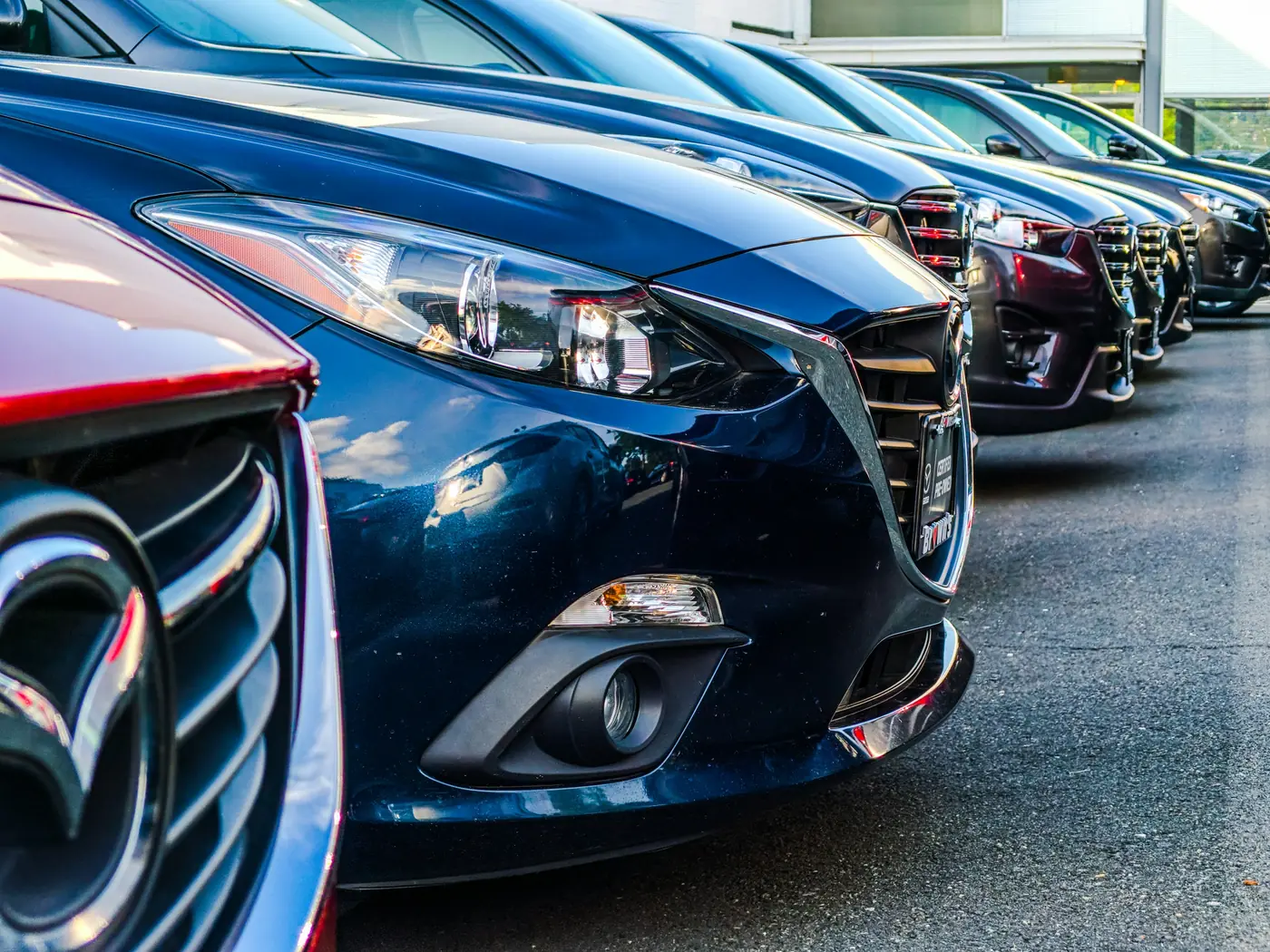
Car sharing is short-term access to cars that members book and open themselves. It works in four steps:
Free-floating services let customers end the trip anywhere inside a zone; station-based and round-trip services bring the car back to a fixed place.
Car rental gives a customer a car for a longer period, usually a day or more, under a rental agreement. Traditionally the car is handed over at a counter or delivered, with a check of documents, a deposit and an inspection at pick-up and return. Digital rental moves the same steps into an app: online booking, ID check, deposit, photo handover and keyless pickup.
Inside the platform · demo data
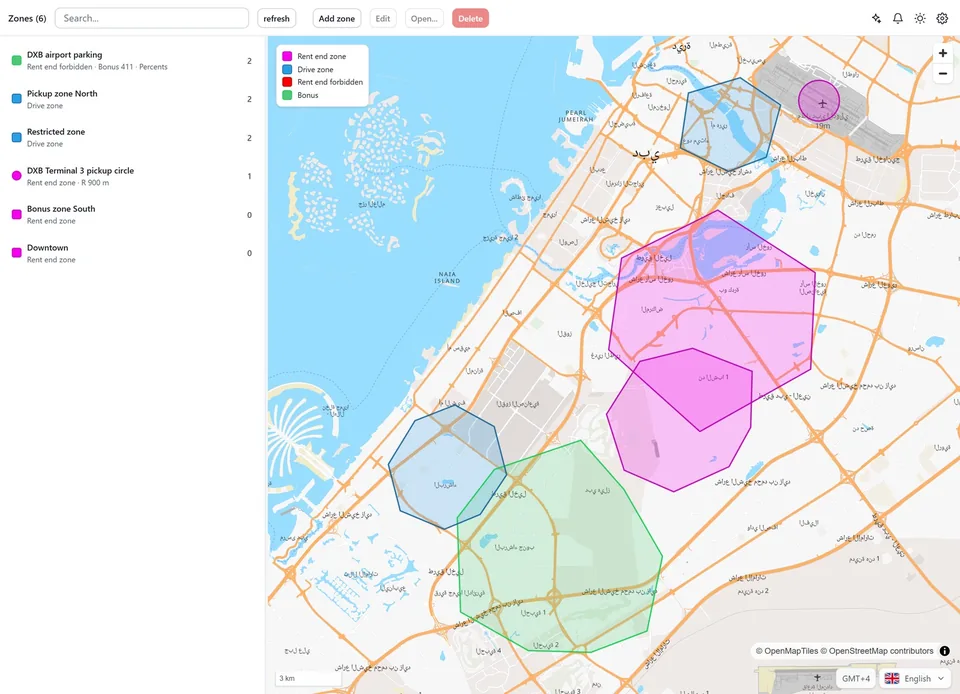
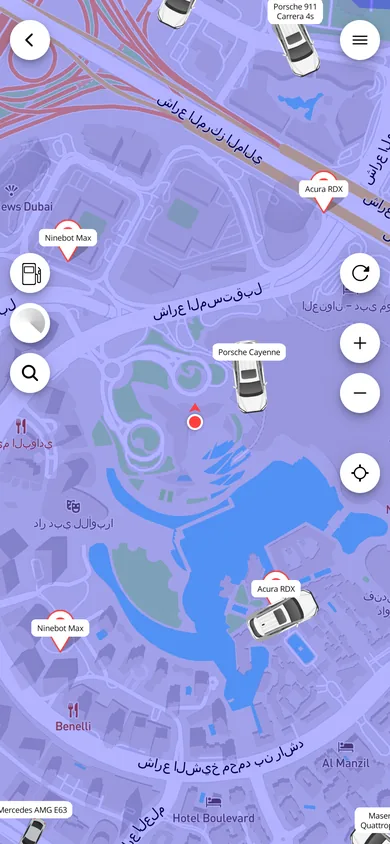
Zones. Rent-end zones, drive zones, restricted zones and an airport parking zone drawn on the map. Customers see the available cars around them in the app.
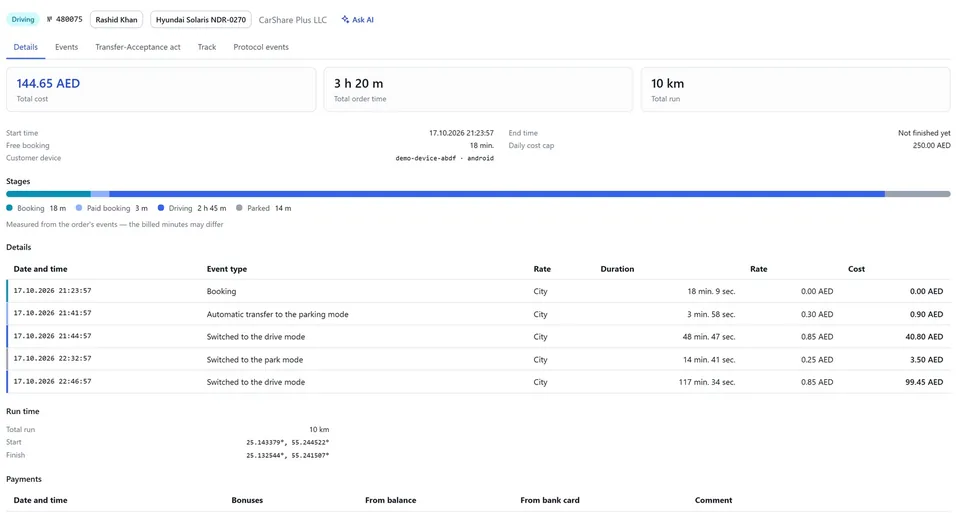
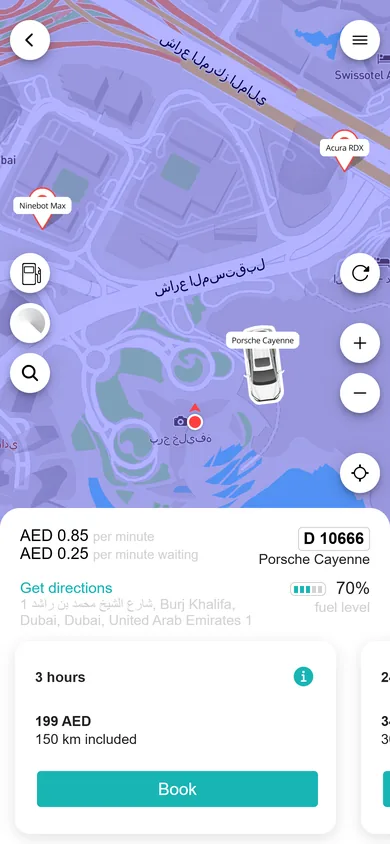
Who had the car. Each rental record shows the driver, the car, the time, the distance, the billing lines in AED and the start and finish points. In the app, customers can choose packages such as 3 hours with 150 km included.
| Car sharing | Car rental | |
|---|---|---|
| Typical duration | Minutes to hours | Days to weeks, sometimes months |
| Price | Per minute, hour or kilometre, packages | Per day, week or month, plus extras |
| Handover | Self-service, unlock by phone | Counter, delivery or keyless pickup |
| Customer check | Once, at registration | For each rental, often with the contract |
| Where the cars are | Spread across a zone or at stations | At branches, airports or delivered |
| Staff per rental | Close to none; field teams clean, refuel and move cars | Desk staff for pickup and return, unless digital |
| Deposit and contract | Card on file, terms accepted in the app | Deposit and a rental agreement per rental |
| Damage and fuel | Photos by the customer before and after each trip | Inspection at pickup and return |
| Fines and tolls | Matched to the trip by plate and time | Matched to the rental by plate and time |
| What drives revenue | Many short trips per car per day | Days on rent per car per month |
For both models, the revenue of a car is the time it is on rent multiplied by the price for that time. Rental fills a car with long blocks of days at a lower price per hour; sharing fills it with short trips at a higher price per hour but leaves gaps between them. A simple way to compare them for your own fleet:
Put your own prices and your own usage into both lines. Sharing pays when demand is dense: many people within walking distance who need a car for an hour. Rental pays when customers need a car for whole days: tourists, business travellers, replacement cars and companies that rent by the month.
| Situation | Better fit |
|---|---|
| Dense city district, residents and offices nearby | Car sharing (free-floating or stations) |
| Airport, hotels, tourists and business travellers | Car rental, ideally with keyless pickup |
| Residential community or campus with its own cars | Station-based car sharing |
| Companies that need cars for staff by the month | Monthly rental or corporate car sharing |
| Rental fleet with idle cars on weekdays | Both: rental for days, sharing for hours |
The line between the models is fading. Rental companies add per-hour and keyless rentals to fill idle days, and sharing operators add daily and monthly packages for longer trips. Running both needs one platform that handles per-minute, hourly, daily and monthly tariffs, deposits, keyless access and photo handovers on the same cars.
CT Mobility is that kind of platform: a white-label app under your brand, telematics and keyless access, tariffs for every period and a back office for customers, payments, fines and maintenance. See car sharing software and the car rental app, and for rental companies in Dubai and the UAE, car rental software with Salik and fines per rental.
A third model shares cars inside one company: employees book pool cars for work trips, without a price per trip. It uses the same technology as car sharing, with access rules instead of tariffs. See corporate car sharing software and motor pool management software.
Pilot for UAE companies: we connect up to 2 of your vehicles with no subscription fee for 3 months, so you can judge the results on your own operations before any commitment. Only the hardware, installation and mobile data are paid. Go live in about 15 days.
CT Mobility Solutions F.Z.C. · E-Commerce Hub BC-8, Ajman Free Zone C1 Building, Ajman Free Zone, Ajman, United Arab Emirates
Car sharing is self-service access for minutes or hours, booked and unlocked by phone and priced per minute, hour or kilometre. Car rental gives a car for days or weeks under a rental agreement, with a deposit and a handover at pickup and return.
For the customer, sharing is usually cheaper for short trips and rental for whole days. For the operator, what matters is how many hours or days each car is on rent and at what price.
Members register once and pass ID and licence checks, find a car in the app, unlock it by phone, drive and end the trip in an allowed zone or at a station, and the price is charged automatically.
It depends on demand. Sharing pays where many people need a car for an hour within walking distance; rental pays where customers need cars for whole days. Many operators run both on the same fleet.
Yes, with a platform that supports per-minute, hourly, daily and monthly tariffs, deposits, keyless access and photo handovers on the same cars. CT Mobility supports both.
Car sharing does, because cars are opened without a key. Rental can work without it, but keyless pickup, tracking and fuel and mileage records need a telematics unit in each car.
We have repeatedly proven this in practice with dozens of launched projects and years of successful work. Ask our clients who have tried several IT solutions but still remain with us.




