Monday, 09:20, the finance office of a car sharing service in Dubai. The weekly sheet says last Friday brought in AED 18,400 against AED 21,900 the Friday before, 16% down, and the management call is at 11:00. The finance lead wants one sentence for that call. Before anybody writes it, the answer has to settle two dull things: by whose clock Friday is counted, and which money is being counted. Somewhere along the way it also has to say plainly where the records stop. The business, the numbers and the conversation below are an illustrative example, not a customer case, and no results are claimed.
Short answer: Before explaining a drop between two days, check which clock and which date each figure uses (trip start, trip end or payment), whether payments tie to trips or include refunds and holds from other days, whether the latest day is complete and the numbers big enough to compare, and whether the two days were really alike. Then give each explanation a label: confirmed by the records, consistent with them but not proven, or not in the records, together with the person or document that could settle it.
Last updated:
November 21, 2026

Friday evening is the busiest stretch of this service’s week, so a Friday that drops 16% gets noticed. The sheet is filled in every Saturday morning from finance’s own export, and nobody quite remembers how that column is built.
The finance lead has ChatGPT connected to the platform through the MCP server built into CT Mobility, and types the question the way most of us would at 09:20:
Finance lead: friday revenue 18,400 vs 21,900 the friday before. why the drop? need one line for the 11:00 call
There are two easy answers, and we wouldn’t take either. One repeats the 16% and adds reasons that sound right, like the weather or a slow week. The other quietly picks its own meaning of “Friday” and “revenue”, computes something and hands it over as the explanation. A careful answer starts somewhere else.
We assume Dubai time throughout, because that’s the clock this operator’s customers and staff live by. Dubai is four hours ahead of UTC all year. Whatever any system keeps underneath, the question should name the clock.
A day counted in UTC runs from 04:00 on Friday to 04:00 on Saturday in Dubai. Put a UTC report next to a Dubai one and the first four hours of Friday move to Thursday, while the late part of Friday night, after midnight, comes back in as Friday. Then there’s the trip that starts at 23:40 on Friday and ends at 00:50 on Saturday. By start time it belongs to Friday. If its charge is dated when the trip ends, the money belongs to Saturday. Skip this and you compare two days that were cut differently, and the difference looks like demand.
Every payment in the comparison should lead back to a trip. Some won’t. A refund paid on Friday for a trip from Tuesday lands in Friday’s money. A card hold is placed on one day and released on another, and it was never money received in the first place. And now and then a payment isn’t linked to any trip at all. Our revenue reconciliation walkthrough sorts these out for a whole month. On a single day they weigh more: one AED 450 refund is about 2% of a Friday here.
On Monday morning, last Friday may not be finished in the records. A failed payment can still go through. And one Friday against another is two days, so a zone with a few dozen trips an evening can swing a long way from one week to the next. Check the filter too: a report that picks zones by name will miss a zone added since it was set up.
Same weekday is only the start. Was one of them a public holiday, or the first day of school holidays? Did an event fill one part of the city? Did the team move cars between zones that afternoon? None of that sits in a trip table. Someone has to remember it or look it up.
The finance lead asks again, this time with the checks built into the question:
Finance lead: redo it. dubai time, friday 00:00 to 23:59. show trips by start time with their charges, and payments by the day they were recorded, refunds taken off, holds left out. which one does my sheet match? read only
ChatGPT: Both Fridays, counted both ways:
| Friday before | Last Friday | Change | |
|---|---|---|---|
| Your sheet, AED | 21,900 | 18,400 | −16% |
| Payments recorded on Friday, refunds taken off, AED | 21,900 | 18,400 | −16% |
| Trips started on Friday | 412 | 371 | −10% |
| Charges for those trips, AED | 21,300 | 19,600 | −8% |
ChatGPT: Your sheet matches the payment view to the dirham, so it most likely counts payments by the day they were recorded. I can’t see how the sheet is built, so check with whoever fills it in. For last Friday the two views differ by AED 1,200. 14 trips that started on Friday evening ended after midnight and were paid on Saturday (AED 780), 8 trips have a failed payment (AED 410), and an AED 450 refund for a Tuesday trip was paid on Friday. The other way, 6 trips from Thursday night were paid on Friday (AED 370) and 2 payments aren’t linked to any trip (AED 70). For the Friday before, the same kinds of lines add up to +AED 600.
So about half of the 16% is the way the money was dated. Counted by trips, last Friday was 8% down in value and 10% in volume, and an average trip was worth about the same both weeks, AED 52 to 53. The real question is the 41 missing trips.
Finance lead: where did the 41 trips go? by hour and by zone
ChatGPT: Almost all of them are in the evening. Trips started between 18:00 and midnight: 168 the Friday before, 131 last Friday. The rest of the day: 244 and 240. By zone, “Marina” accounts for 29 of the 37 evening trips, with 61 the Friday before and 32 last Friday. The other zones together went from 107 to 99 in the evening. On the Friday before, Marina’s evening trips peaked between 22:00 and 23:00. I’m looking at trips that started there, which is a different thing from how many cars were free to book.
The ops lead, copied in, remembers a big event near the Marina on the Friday before. It sounds like the answer, which is exactly when to slow down.
Finance lead: so it was the marina event the friday before? and has last friday’s 18,400 actually reached the bank?
ChatGPT: I can’t answer either from the records I can read. They show 61 evening trips from Marina the Friday before and 32 last Friday, with the earlier Friday peaking between 22:00 and 23:00. They don’t say there was an event, when it ended or how many people came. Someone who was there or has the event’s schedule can tell you whether the times line up. On the bank: I see payments recorded in the platform. Whether the payment provider settled them, and on which day, is in its settlement report. And the 8 failed payments from last Friday can still change the figure.
That last answer is the one you hope for. It says what the records show and where they stop, and it names who could fill the gap. Nothing makes an AI model stop there on its own every time, though. A question that names the clock and the date rule, and asks which figure matches, gives it room to do so and gives you a way to spot when it hasn’t. The bank side stays with finance in any case: records that agree with each other still leave open whether the money landed, and that check is done with settlement reports and statements.
Operator console · demo data
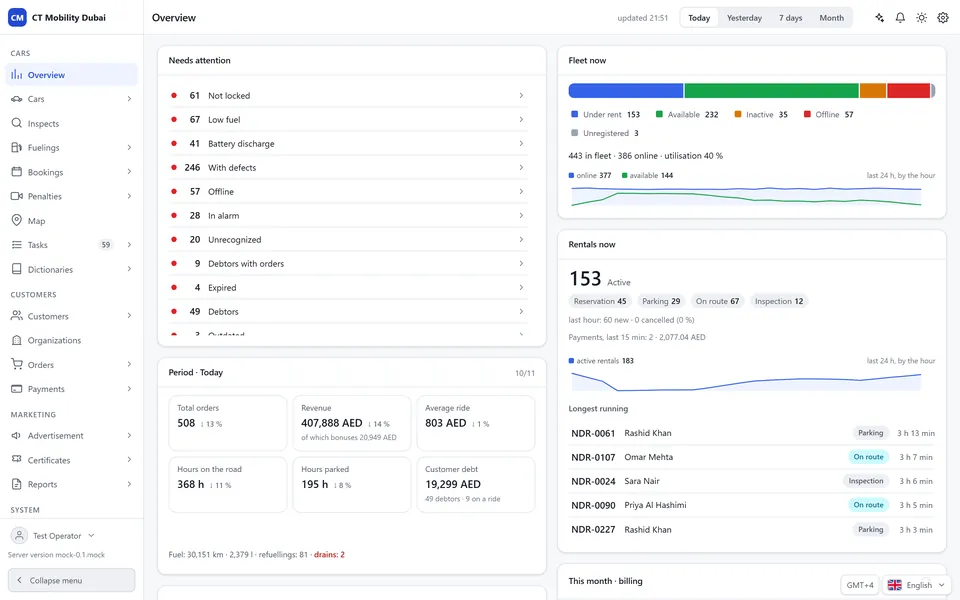
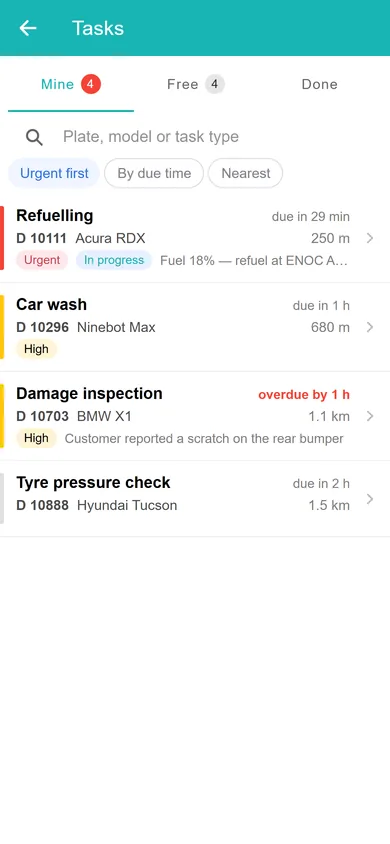
Fleet overview. Utilisation, active rentals, revenue in AED and the cars that need attention: the figures the assistant reads when you ask about your fleet. Technicians get a prioritised task list.
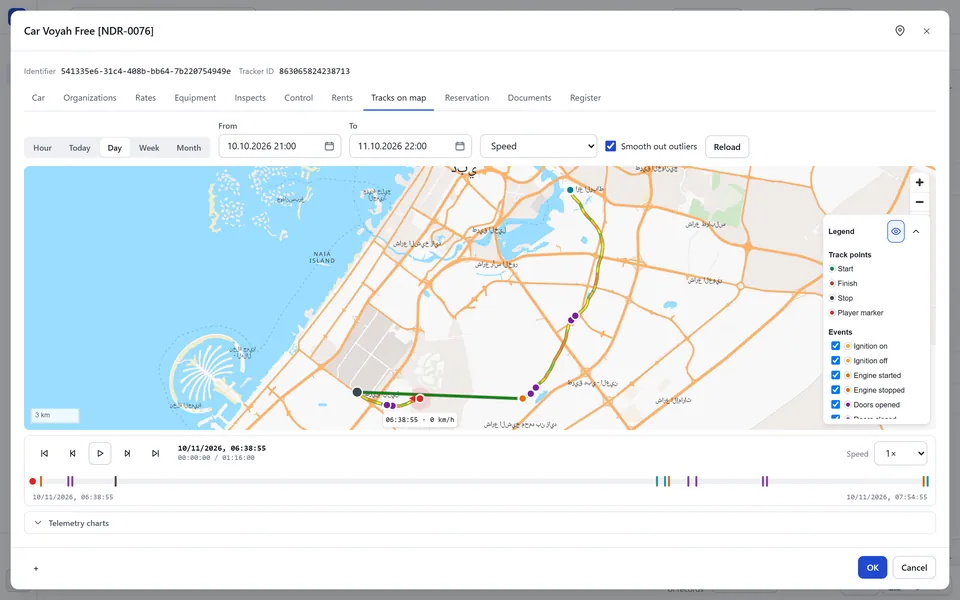
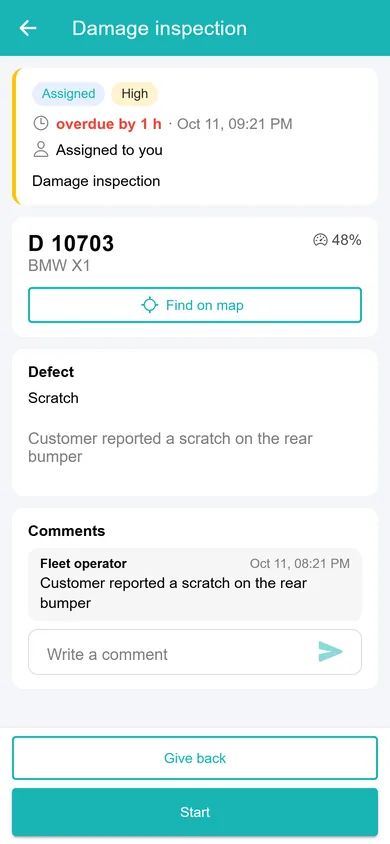
Trips and events. Every trip is stored with ignition, door and speed events, so a question like “who drove this car on Tuesday?” has a recorded answer. Damage reports become tasks for the team.
By 10:30 there are four explanations on the table. Each gets one of three labels, and the label goes into the line for the call.
| Explanation | What the records show | Label | Who can settle it |
|---|---|---|---|
| About half of the 16% is how the money was dated | The sheet equals payments recorded on Friday, to the dirham. Trips started on Friday are 8% down in value | Confirmed by the records | Whoever fills in the sheet, on how it’s built |
| 41 fewer trips, 37 of them in the evening and 29 in Marina | Trips by start time, hour and zone | Confirmed by the records | Nobody needs to. Why it happened is the next two rows |
| An event near the Marina lifted the Friday before | Marina’s evening trips peaked 22:00–23:00 that Friday. Nothing about an event | Consistent with the records, not proven | The ops lead, with the event’s date and hours |
| Fewer cars free to book in Marina last Friday evening | Trips that started there, but not how many cars were free | Not in the records | The field team: where cars stood on Friday afternoon and evening |
The line for the call came out as four sentences: “Last Friday was down 8% in trip value; the rest of the 16% is how payments were dated. The drop sits in Friday evening in the Marina. We think an event lifted the Friday before and we’re checking. Last Friday’s figure can still rise by up to AED 410.”
The habit we’d take from this morning costs three lines at the top of any question about money or volume:
Then one request at the end. Give each line a source and keep a line for whatever can’t be explained. Asked that way, the answer has somewhere to put “not in the records”, and you can see at a glance whether anything landed there.
On control: Ask your fleet, the MCP server built into CT Mobility, works under each employee’s own login and permissions and is read-only by default. Changes work only if the employee allowed them when connecting, each one waits for a confirmation, and every call goes into the audit log. We enable it per installation, on request. Everything in this walkthrough was a read.
For quick figures inside the control panel, such as trips by zone for two days, the AI Data Assistant is enough. Before you connect an AI tool to payment data, read our guide to connecting ChatGPT and Claude safely. The same care with timestamps runs through the morning with six quiet cars.
CT Mobility Solutions F.Z.C. · E-Commerce Hub BC-8, Ajman Free Zone C1 Building, Ajman Free Zone, Ajman, United Arab Emirates
Whatever the platform covers and the signed-in employee may see: vehicle status and live telematics, trip history, customers and payments, fines recorded in the platform, zones and tariffs, technician tasks, alarms and statistics.
Yes. You can ask in your own language, and the AI replies in the language you use.
There’s no public price. We enable it per CT Mobility installation on request, so the quickest way to find out is to book a demo from the Ask your fleet page and ask about your fleet.
We have repeatedly proven this in practice with dozens of launched projects and years of successful work. Ask our clients who have tried several IT solutions but still remain with us.




