Nearly all of Germany’s car sharing providers work from fixed stations. When one applies for station spaces on a federal road, the annex of the Carsharing Act (Carsharinggesetz, CsgG) puts several demands on its software. Outside figures and legal texts are linked to their sources as they stood on 14 November 2026.
Short answer: CT Mobility is white-label car sharing software: an app under your brand for iOS and Android, a control panel for your team and keyless access to the cars. Of the 293 providers counted in Germany in January 2026, 287 run station-based (stationsbasiert) or combined services, with about 64 vehicles each by our arithmetic. We charge no setup fee and bill per active vehicle, from one vehicle up. A typical launch takes about 15 days. None of our car sharing clients is German yet; the nearest are in Prague, Cyprus and Belgrade.
Last updated:
November 14, 2026

On 1 January 2026 the Bundesverband Carsharing (bcs), the providers’ umbrella association, counted 293 companies, cooperatives and associations offering car sharing (source). Its data sheet puts 287 of them under station-based and combined systems, with 18,390 vehicles, 8,740 stations and 978,300 registered drivers. The other six are free-floating providers with 24,800 vehicles, and the sheet counts 53 municipalities with free-floating car sharing (source). By our arithmetic the 287 average about 64 vehicles each, two to a station, with 53 registered drivers per vehicle. And 1,047 of the 1,490 municipalities with car sharing have fewer than 20,000 inhabitants (source, page 3).
Put a vendor’s price list next to a fleet of 64. Hamburg-based Wunder Mobility publishes a monthly minimum of EUR 18,250 with 500 vehicles included (source). Spread over 64 cars, that’s about EUR 285 a car each month by our sum. Our monthly fee follows the number of active vehicles. We set the public facts side by side on our Wunder Mobility alternative and ATOM Mobility alternative pages.
The Act took effect on 1 September 2017 (source). §3 allows privileges for parking and parking fees on public roads, and §4 ties them to a clearly visible car sharing marking on the vehicle.
§5 is the one for a station-based service. The authority named by state law can set aside spaces where a federal road passes through a town and give them to one provider under a special-use permit (Sondernutzungserlaubnis) for eight years at most. It has to run a transparent, non-discriminatory selection procedure (Auswahlverfahren), and if several providers qualify, lots are drawn. The paragraph covers federal roads only, so ask your town which legal basis its own procedure uses.
Under §5(4) the suitability criteria come from the annex of the Act until a first ordinance sets them. Seven of its points touch software.
| Annex no. | What it asks | What you must be able to show from your software |
|---|---|---|
| 1.1 | As a rule, every adult who presents a valid licence for the vehicle is admitted without discrimination, capacity permitting. Limits by licence tenure, minimum age and credit check are allowed | The licence record from sign-up and the same admission rules for every applicant |
| 1.2.1 | Booking, pick-up and return are possible 24 hours a day | A night booking, opened and returned with no staff involved |
| 1.2.2 | Rentals from one hour are possible, and the hourly rate may not exceed 20% of the day price | Hourly rate and day price in one tariff. At EUR 50 a day, the hour costs EUR 10 at most |
| 1.2.3 | No free kilometres, except for trips to refuel or charge, for vehicle care, or to win or keep customers. The charge per kilometre must be above the usual market cost of fuel or electricity | A kilometre price in every tariff, and how a refuelling trip is credited |
| 1.2.6 | Holders of public transport season or discount cards should get a discount, unless the card’s issuer runs car sharing itself | A reduced tariff for one customer group and the step where the pass is checked |
| 1.3 | At least 10 registered drivers per vehicle for up to five vehicles and 15 for larger fleets, counted per municipality. A provider new to the municipality is exempt | Registered drivers and vehicles per municipality on a given date |
| 1.5 | Vehicle status data should be released to support multimodal travel, unless intellectual property or trade secrets stand in the way. No personal data | A vehicle status feed with no customer data in it |
The rest sits outside the software: maintenance to the manufacturer’s recommendations (1.2.4), a pointer to eco-driving courses (1.2.5) and, for electric cars, information on charging stations and the origin of the electricity (1.4). Under Part 3, an authority responsible for no more than 50,000 inhabitants may deviate from single requirements if local circumstances justify it and a call for interest showed that no provider would apply otherwise.
Treat the third column as a checklist for any vendor, us included. Whether a service meets the annex is the authority’s call. On our site you can see per-minute, hourly and daily tariffs, time- and distance-based pricing, keyless access around the clock without key handover, report exports and an Open API with webhooks for vehicle status. A status feed to a city’s mobility platform is integration work we’d scope with you.
Inside the platform · demo data
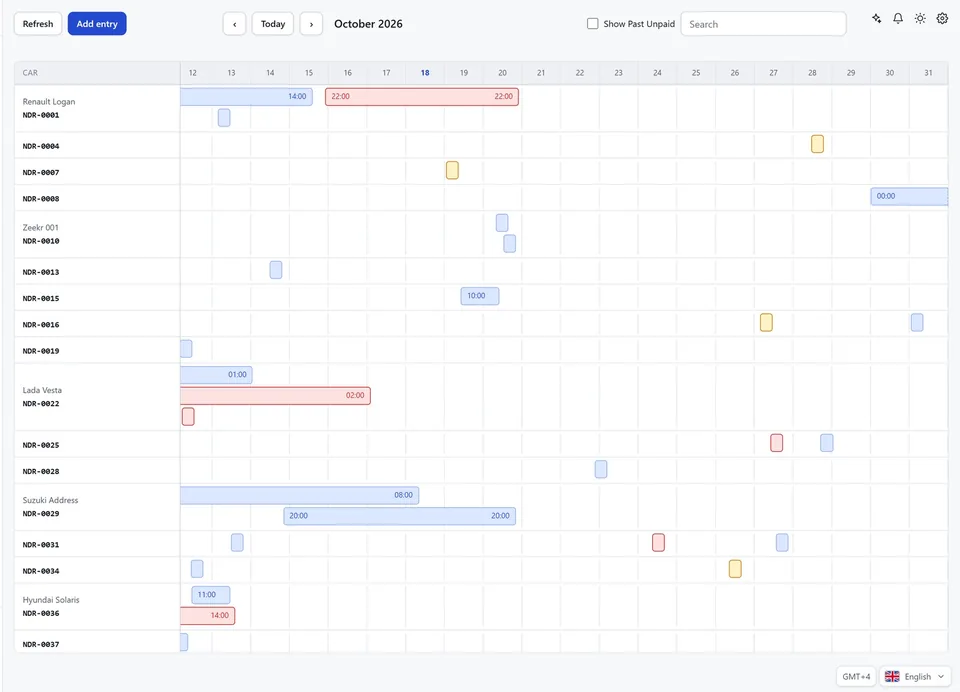
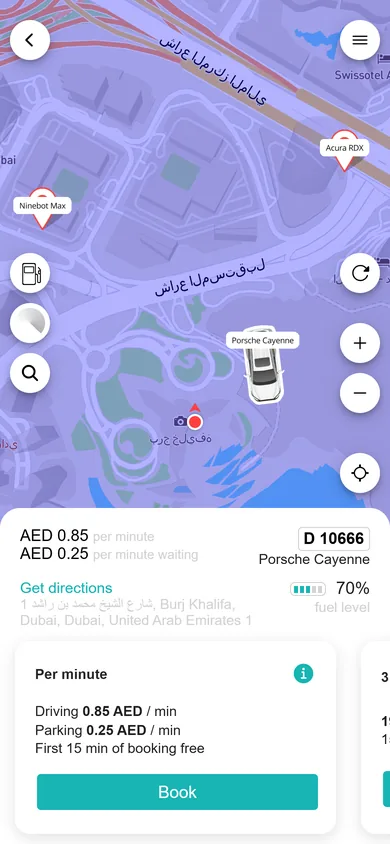
Bookings calendar. Cars as rows and reservations as bars, so free slots are visible at a glance. In the app, the car card shows the rate and fuel level, and the car is booked with one tap.
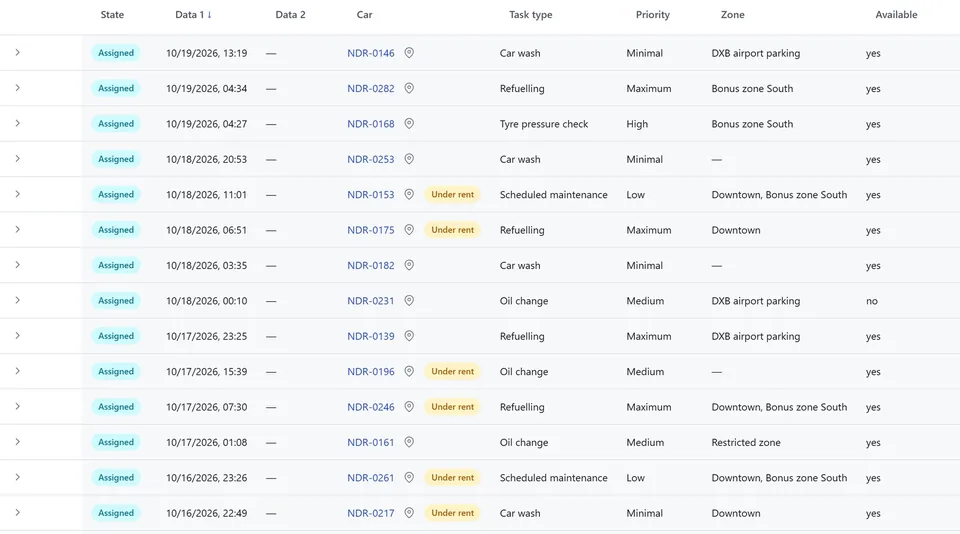
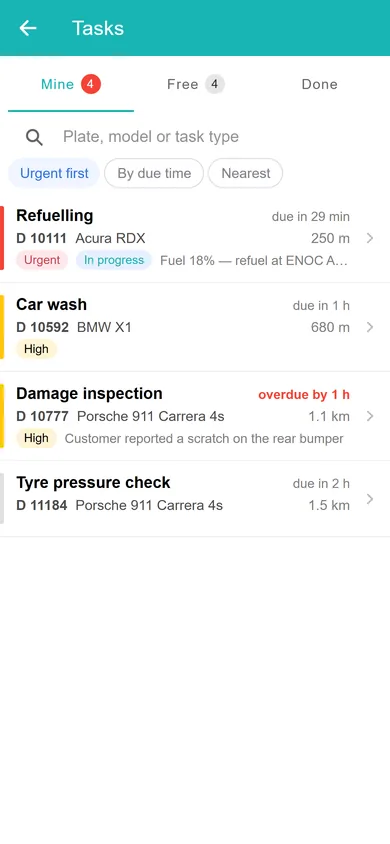
Service tasks. Car washes, refuelling, tyre checks and scheduled maintenance with priority and zone. Each technician sees their own tasks sorted urgent first, with the due time and distance.
The Blue Angel (Blauer Engel) is the German government’s ecolabel, and it’s voluntary (source). Its car sharing criteria, DE-UZ 100 in the June 2025 edition, start from the annex and set the bar a little higher in places. Two points reach the software. The provider commits to supplying data to public multimodal platforms and to municipalities for planning: station locations or operating areas, vehicle sizes and current availability. It also has to measure how far its service relieves traffic, by the bcs evaluation standard, and repeat that at least every four years (source, sections 3.1.3 and 3.3).
§21 of the Road Traffic Act (Straßenverkehrsgesetz, StVG) punishes a vehicle’s keeper (Halter) who orders or allows someone to drive it without the required licence, with up to a year in prison or a fine. Negligence is punishable too, with up to six months or a fine (source). The paragraph names no method and no interval for checking a licence, so agree a procedure with your lawyer and have the vendor show it in the sign-up flow. On our platform riders pass ID and driving licence verification with liveness detection, and identity verification platforms such as Sumsub can be connected.
Then the money. In the ECB’s 2024 payment survey, e-payment solutions such as wallets and PayPal made up 46% of online payments in Germany. In the euro area outside Germany, the Netherlands and Portugal, cards were still the most used instrument online. For recurring payments, direct debit was the most used method across the euro area (source). teilAuto’s terms say the invoice is collected by direct debit (Lastschrift) (source). In stadtmobil Rhein-Ruhr’s terms the customer grants a SEPA direct debit mandate (source).
We’ve integrated more than 15 payment gateways, including Stripe, PayPal, Apple Pay and Google Pay, and several can run at the same time. If your members pay by direct debit, raise it in the first call. We’ll tell you whether a gateway we already work with covers it or whether it needs integration work.
Under the GDPR (DSGVO in German), the provider that decides why and how member data is processed is the controller, and a software vendor handling the data on its behalf is a processor. The European Data Protection Board’s guide says the two need a contract. In it the processor takes on another processor only with the controller’s written authorisation and deletes or returns the personal data when the service ends (source). The European Commission publishes standard clauses for it (source). Before you sign with anyone, ask for the draft agreement and the sub-processor list, and ask where the servers are.
There’s no setup fee. The monthly fee is by quote and depends on the number of active vehicles, with discounts for larger fleets. Telematics hardware is quoted separately after a vehicle review. A typical launch takes about 15 days if the hardware is available and the cars are ready for installation.
Take a cooperative planning six cars at three stations in a town of 30,000 people (our example, for illustration). We’d start like this:
CT Mobility Solutions F.Z.C. · E-Commerce Hub BC-8, Ajman Free Zone C1 Building, Ajman Free Zone, Ajman, United Arab Emirates
Yes. Fixed stations and free-floating zones run on one platform, so a station-based service can add a free-floating zone later and keep its software.
Yes. A business client gets a B2B portal for employee access and monthly ride limits, and you can set aside a private fleet for one company. More on the corporate car sharing software page.
The platform reads the battery level through the telematics unit, and battery level can be a variable in a tariff. Anytime in Prague runs hybrid and electric cars on it. If you need a link to a charging network, tell us which one in the first call.
We have repeatedly proven this in practice with dozens of launched projects and years of successful work. Ask our clients who have tried several IT solutions but still remain with us.




