This page is for a team planning a car sharing service in a Latin American city. It covers the two things that change most from country to country, how customers pay and which electronic invoice the tax authority expects, and it says what we can and can’t tell you about our software there. Figures from outside sources are linked to those sources as they stood on 16 November 2026.
Short answer: CT Mobility is white-label car sharing software: an app under your brand for iOS and Android, a control panel for your team and keyless access to the cars. There’s no setup fee, the monthly fee depends on the number of active vehicles, you can start with one vehicle and a launch takes about 15 days. Mercado Pago is among the more than 15 payment gateways we’ve integrated and several gateways can run at the same time. No operator in Latin America runs on our platform yet. The ones we can name are in Europe.
Last updated:
November 20, 2026
An online shop takes one payment for a known amount. A car sharing service needs more from a payment method. It needs a deposit or a hold before the trip, a charge after the trip for an amount nobody knew at the start, and a way to charge again weeks later for a fine or for damage.
Cards allow a hold. Stripe’s documentation says only some payment methods support separate authorisation and capture and names cards among them (source). Several local methods work another way. The customer approves each payment in a bank app, or pays cash against a voucher. The table gives what each scheme or its documentation says and the question we’d put to any vendor.
| Country | A local way to pay, as its source describes it | The tax document | Ask any vendor, us included |
|---|---|---|---|
| Brazil | Pix, “a real-time payment system developed by the Central Bank of Brazil”. The customer approves each payment in a banking app. Recurring charges need Pix Automático, a mandate the customer authorises in that app, and a charge above the mandate amount fails. Stripe doesn’t offer Pix Automático to businesses domiciled in Brazil (Stripe’s documentation) | The Nota Fiscal de Serviço eletrônica (NFS-e), the invoice for services, has a national portal (source). Whether a car rental falls under it or needs another document is a question for your accountant | Where does the deposit sit when the trip is paid with Pix? |
| Mexico | OXXO: the customer receives a voucher and pays cash in an OXXO store. Vouchers expire after 5 days by default, confirmation comes by the next business day, and refunds and recurring payments aren’t supported (Stripe’s documentation) | CFDI, the factura electrónica of the SAT. Version 4.0 has been the only valid one since 1 April 2023, and the receiver’s name, tax regime and fiscal address are mandatory (source) | What does sign-up collect from a customer who wants a CFDI? |
| Colombia | PSE, the Pagos Seguros en Línea button of ACH Colombia. Customers authorise the debit from a savings account, a current account or an electronic deposit account in their bank’s online banking (source) | DIAN’s invoicing system covers the factura electrónica de venta and “documentos equivalentes” (source) | The customer authorises each PSE payment. How is a charge after the trip collected? |
| Chile | Webpay Plus, Transbank’s gateway, takes debit, prepaid and credit cards, with or without instalments (source) | The boleta electrónica has been mandatory since 2021. The SII says the electronic receipt of a card payment is valid as a boleta (source) | Can a deposit be held on a debit or prepaid card? |
| Argentina | In July 2026 the BCRA counted 777.2 million instant transfers in pesos and 115.6 million payments started with a QR code. The same report puts the interoperable digital wallets registered with it at 91 (source) | ARCA’s factura electrónica. The comprobantes carry a QR code (source) | Can a transfer or a QR payment cover the deposit, or does that take a card? |
| Peru | Yape, an app for transferring money, says it has more than 19 million users (source) | SUNAT lists several SEE routes for comprobantes de pago electrónicos, among them SEE - SOL, the taxpayer’s own systems and an Operador de Servicios Electrónicos (source) | How does a customer who pays with Yape leave a deposit? |
Mercado Pago’s developer documentation for Argentina lists credit or debit card, Rapipago, Pago Fácil, Cuenta Mercado Pago and Cuotas sin Tarjeta for its Checkout Pro (source). It describes a hold, “reserva de fondos”, for card payments, to be captured within 5 days (source).
Our reading of the OXXO terms: a payment that is confirmed by the next business day and can’t be refunded doesn’t work as a deposit before a trip. For Pix, PSE and Yape the pages above don’t say whether money can be held, so put that question to the gateway in writing.
Now our side. We’ve integrated more than 15 payment gateways, including Stripe, PayPal, Apple Pay, Google Pay and local ones such as Mercado Pago, and several can run at the same time. The billing module handles deposits, refunds and unpaid invoices, and payments can run in several currencies. If you prefer a local gateway that we haven’t connected, you can suggest it; connecting a new system is scoped per project.
Two things we haven’t published and you should ask us in the first call: whether any operator takes payments through our Mercado Pago integration today and in which countries, and which Mercado Pago methods (Pix, QR, account balance, instalments) work through it. Ask us as well to confirm that the gateway you choose takes payments in your currency.
Each tax authority in the table has its own electronic document, and the names in the third column are the ones to take to your accountant. Start with two questions. Which document does a rental charged by the minute need? Who issues it: you, a provider authorised by the tax authority, or the payment gateway?
In Mexico a customer who asks for a CFDI has to give a tax regime and a fiscal address, so sign-up has to collect them.
Then ask every vendor what the billing module exports for each payment, and whether it has been connected to an authorised invoicing provider in your country. Our own answer today is short. Our site says the billing module handles “in some countries the fiscalisation of payments”, that is, reporting payments to the tax authority, and no Latin American invoicing system is listed there. Until we’ve confirmed otherwise for your country, plan for integration work through the Open API, which has webhooks and SQL queries for extracting data.
Inside the platform · demo data
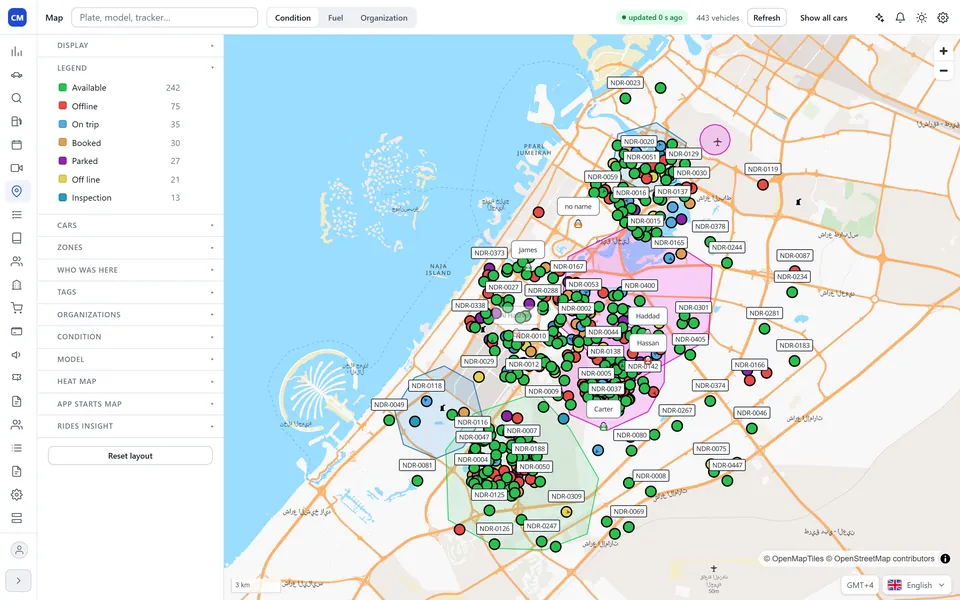
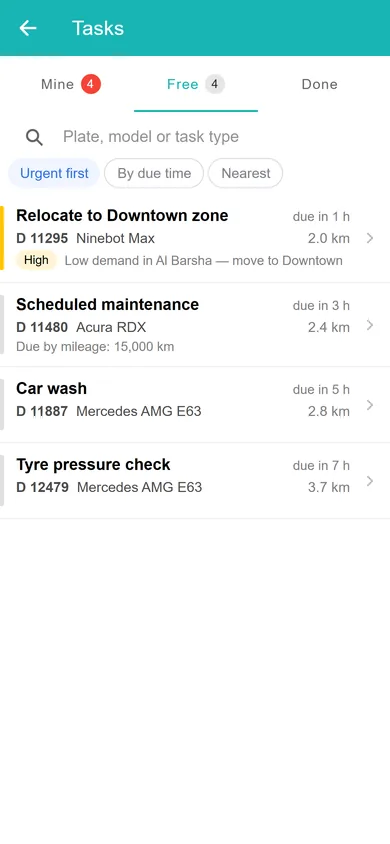
Fleet and field team. Every vehicle and its status on one live map. Open tasks wait in the technician app, where any free technician can take the nearest one.
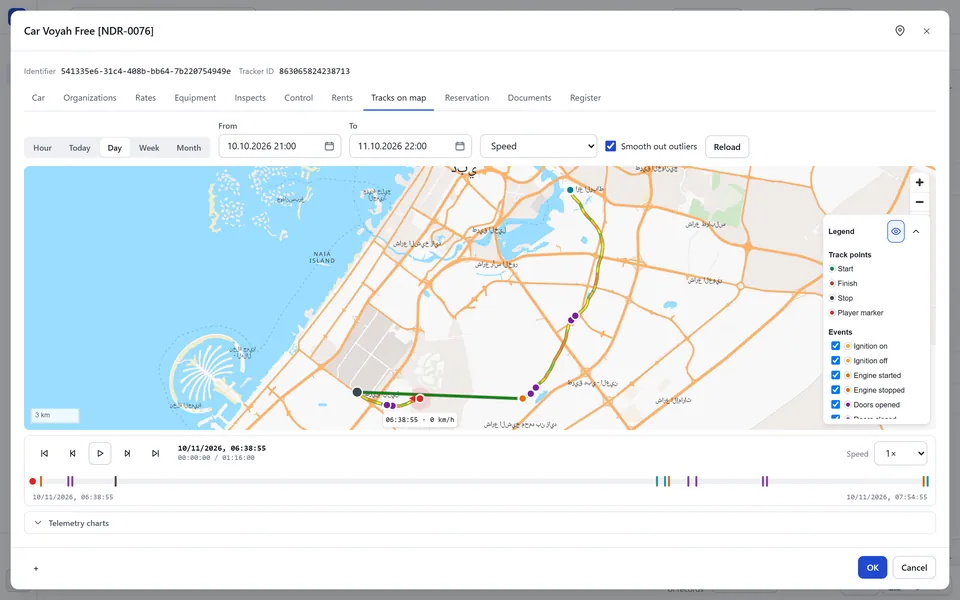
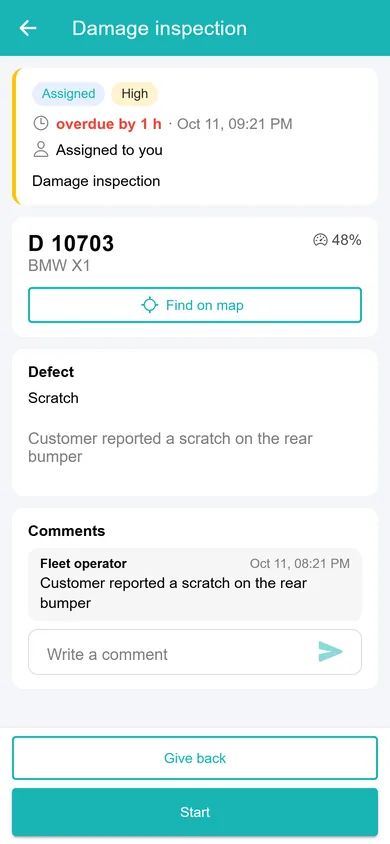
Trip history. Replay any trip with ignition, door and speed events to see exactly who drove and how. Damage reported by a customer becomes a task for your team.
Customers pass ID and driving licence verification with liveness detection before they get access to a car. Identity verification platforms such as Sumsub can be connected, and other providers can be integrated on request. Which national documents the check reads in your country is a question for the first call. Bring sample images of the national ID card and the driving licence.
City rules come from the city and the transport authority, and you want them in writing before you sign for software: the parking terms for shared cars, the data the city wants from you and the receipt a customer must get. São Paulo shows what such rules can look like. The consolidated text of Decreto 56.981/2016 on the city’s legislation site has a chapter on “compartilhamento de veículos sem condutor”. Under Art. 21 only operators accredited by the city may run such a service, and Art. 35 obliges them to share data with the city. The same page marks Art. 22, on the fee for parking use, as declared unconstitutional (source). That’s the text as published. We haven’t checked how the city applies it, so ask the city what applies today.
The operators we can name are in Europe: Anytime in Prague, with more than 600,000 rentals since 2019, RideNow in Cyprus, with more than 500 cars, and AnyGo in Belgrade. We’ve been on the market since 2015.
For a team that works in Spanish or Portuguese, our site is published in Spanish and Portuguese, and the customer app supports any number of languages. Ask us to show you the control panel in yours.
If you’re comparing vendors, we’ve put the published prices side by side on two pages: CT Mobility as an ATOM Mobility alternative and as a Wunder Mobility alternative.
There’s no setup fee. The monthly fee is by quote, per active vehicle, with discounts for larger fleets, and you can start with one vehicle. Each car needs a telematics unit. We work with devices such as Teltonika and quote the hardware after we’ve reviewed your car models. A launch takes about 15 days once the vehicles and hardware are ready.
With 20 to 50 cars, look at each vendor’s monthly minimum before anything else. Wunder Mobility publishes a monthly minimum of EUR 18,250 with 500 vehicles included (source). By our arithmetic that is EUR 365 per car a month for a fleet of 50.
Before the first call with us or with anyone else:
CT Mobility Solutions F.Z.C. · E-Commerce Hub BC-8, Ajman Free Zone C1 Building, Ajman Free Zone, Ajman, United Arab Emirates
Yes. Supported vehicle types include cars, scooters and e-scooters, bicycles and e-bikes and mopeds, managed in one console. Scooter customers start a ride by scanning a QR code, and pricing can be per minute, by pass or by subscription.
Yes. Per-minute, hourly and daily tariffs, subscriptions and B2B rates run on one platform, and you can change the model as the business grows.
Yes. Employees book a pool car in the app, unlock it with their phone and return it to the company parking. Bookings can be limited by role, team and usage schedule.
We have repeatedly proven this in practice with dozens of launched projects and years of successful work. Ask our clients who have tried several IT solutions but still remain with us.




