This page is for a team planning or running a small car sharing service in a US city: a community programme, electric cars shared at a housing development, a campus or city fleet, or a rental company adding cars by the hour. It covers city permits, the peer-to-peer rules, card payments and rental taxes, and the licence check at sign-up. Outside figures are linked to their sources as they stood on 18 November 2026.
Short answer: CT Mobility is white-label car sharing software: an app under your brand for iOS and Android, a control panel for your team and keyless access to the cars, with no setup fee, a monthly fee per active vehicle, fleets from one vehicle and a launch in about 15 days. Stripe, PayPal, Apple Pay and Google Pay are among the more than 15 payment gateways we’ve integrated. We have no client, pilot, office or partner in the United States yet; the operators we can name run in Prague, Cyprus and Belgrade.
Last updated:
November 21, 2026

A car that parks on city streets between trips needs the city’s permission. Three cities that publish their permit terms online, and the question we’d put to any vendor for each:
| City | What its permit page says | What to ask any vendor, us included |
|---|---|---|
| Seattle | A free-floating permit costs $300 per vehicle, plus 50 cents per trip for combustion or hybrid cars and 25 cents for electric ones. Trip and status data goes to SDOT through APIs in the Mobility Data Specification (MDS) “Provider” format (source) | Can you deliver trips, status changes and a real-time feed in that format? Who builds it, and at what price? |
| San Francisco | On-street permits go only to Vehicle Sharing Organizations with organisation-owned cars, which commit to provide ongoing usage data to the SFMTA (source) | Which usage data can we export, in which file format and how often? |
| Washington, DC | DDOT permits point-to-point and reserved-space car sharing in public space and publishes a data and deliverable guide and its data formats (2023) for permit holders (source) | Can your export be mapped to the District’s formats, and who does the mapping? |
Seattle’s page goes further than the other two. The city produces a quarterly report of trips for each operator, and the operator pays the per-trip charge after reviewing it. A trip starts when a user unlocks a car and ends when the car is released for others. Trips of 0 miles or 30 seconds or less don’t count (source). You’ll want your own trip count, built on the same definition, to check the city’s figure against. The permit also asks for an app that works with screen readers and can be translated into Seattle’s Tier 1 languages.
Our side: the Open API sends real-time events and vehicle status through webhooks, and SQL queries over HTTP pull data into tools such as Google Sheets and Power BI. We don’t have a ready-made MDS feed or a ready-made report for any of these three cities. Plan the city report as integration work and ask us for an estimate once you have the city’s data format in writing. Screen reader support, miles and US date formats are questions for the first call too.
The National Council of Insurance Legislators (NCOIL) has a model act for peer-to-peer car sharing, meant to govern where these services meet the state-regulated business of insurance. It covers “a business platform that connects vehicle owners with drivers” and leaves out rental car companies. Under the act the platform keeps records of each car’s use, among them the times used, pick-up and drop-off locations, the fees the driver paid and the owner’s revenue. It keeps them for at least as long as the personal injury statute of limitations (source). Washington put a similar records duty into its law, chapter 46.74A RCW (source).
Our reading: the act is written for platforms where private owners rent out their own cars, so a service that owns its fleet is more likely to fall under your state’s rental car rules. Which regime applies to you is a question for a lawyer. Either way, ask every vendor how long trip and payment records are kept and whether you can export them all when the contract ends. We haven’t published a retention period, so ask us too.
Inside the platform · demo data
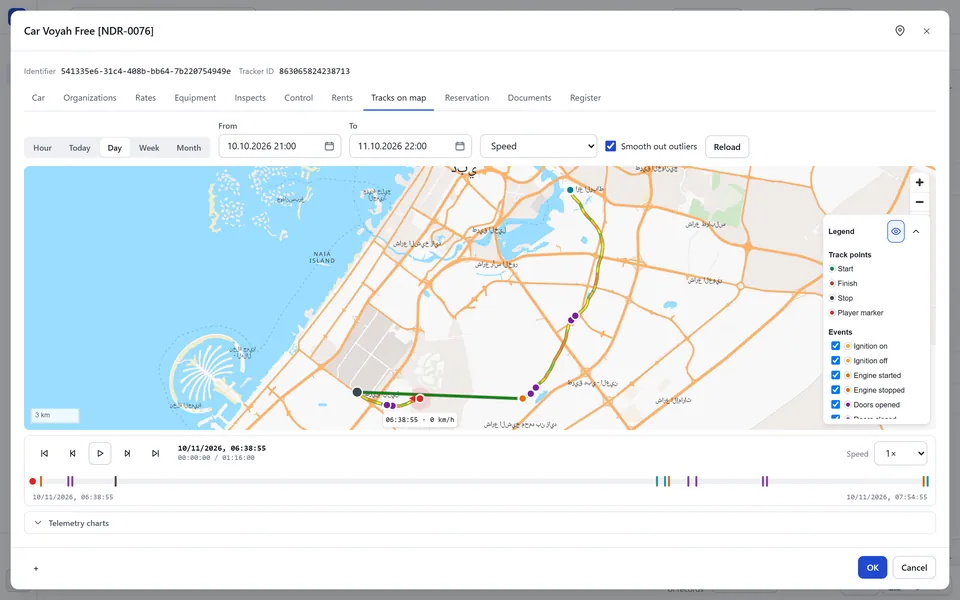
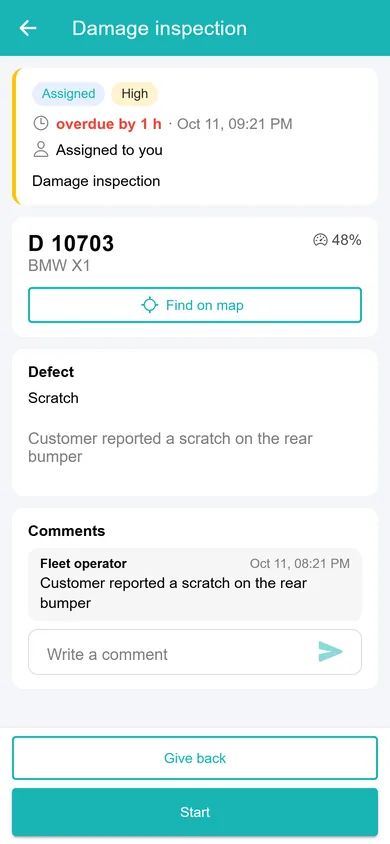
Trip history. Replay any trip with ignition, door and speed events to see exactly who drove and how. Damage reported by a customer becomes a task for your team.
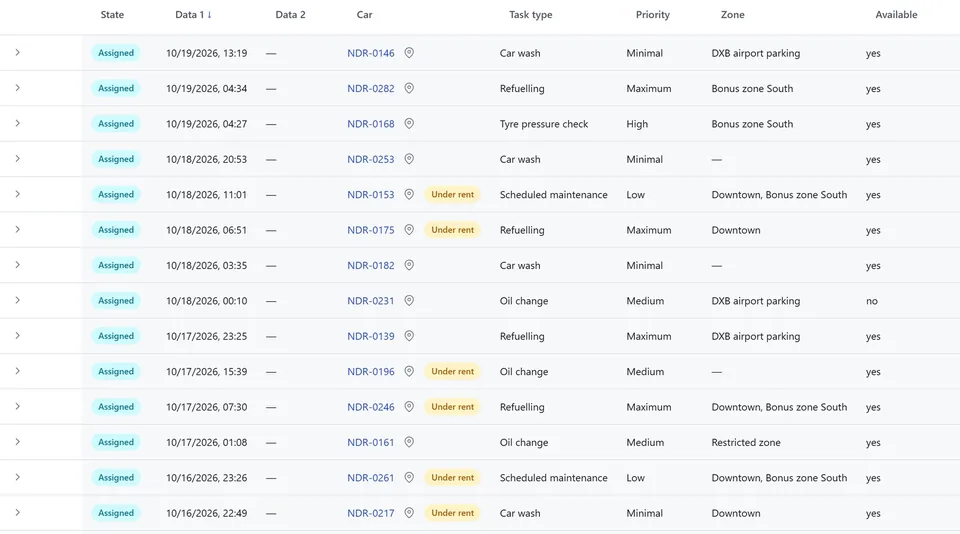
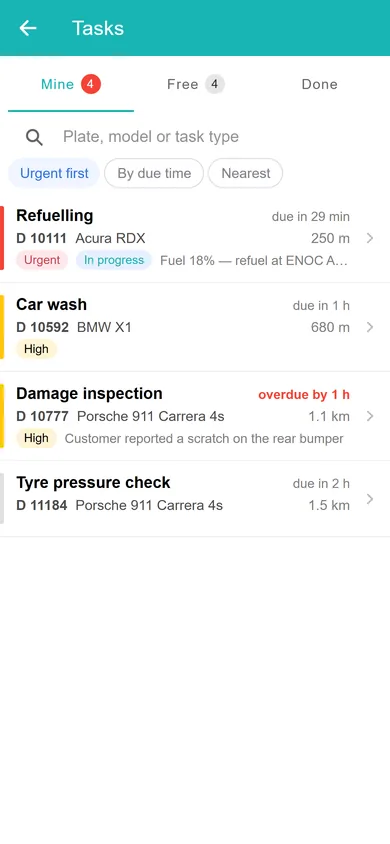
Service tasks. Car washes, refuelling, tyre checks and scheduled maintenance with priority and zone. Each technician sees their own tasks sorted urgent first, with the due time and distance.
Cards carry most of the payments here. The Federal Reserve’s 2026 Diary of Consumer Payment Choice puts credit and debit cards at two-thirds of all payments, with cash used for about 1 in 7 (source). A car sharing service asks more of a card than a shop does: a hold before the trip and the final charge after it.
Stripe’s documentation says an authorisation for an online card payment is usually valid for 7 days, 4 days and 18 hours for a Visa payment started by the merchant, and the funds are released if they aren’t captured in time. It names ACH among the methods that don’t support a separate hold (source). Our reading: a hold taken when someone books a week ahead may lapse before the trip starts.
The Tax Foundation, a think tank, wrote in November 2025 that rental cars get additional sales or excise tax treatment in all 50 states. Its estimates for a sample five-day rental run from 2.0 percent in Delaware to 22.5 percent in Minnesota (source). In Washington the Department of Revenue charges a rental car tax on a passenger car rented for less than 30 days, on top of retail sales tax, at 11.9% in 2026 and 9.9% in 2027. The tax needn’t appear as a separate line on the customer’s invoice, but it has to be kept separate in your records (source).
Our side: we’ve integrated more than 15 payment gateways, including Stripe, PayPal, Apple Pay and Google Pay, and several can run at the same time. The billing module handles deposits, refunds and unpaid invoices, and payments can run in several currencies; check with your gateway that it takes yours. Our site says nothing about calculating US sales or rental taxes, so bring that to the first call.
It depends on which check you mean. One check confirms that the document is genuine and belongs to the person holding the phone. Another confirms the licence against the records of the state that issued it. The NCOIL model act says a peer-to-peer platform may not sign up a driver without a licence for that class of vehicle, and must record the licence number and where it was issued (source). By our reading it leaves the method of checking open.
On our platform customers pass ID and driving licence verification with liveness detection before they get access to a car. Identity verification platforms such as Sumsub can be connected, and other providers can be integrated on request.
A check against state records is a separate service. The American Association of Motor Vehicle Administrators (AAMVA) runs Driver’s License Data Verification (DLDV). The user submits data from the document and gets back a flag for each element saying whether it matches the issuing jurisdiction’s records. AAMVA has to approve every customer before it goes live (source). Nothing on our site says the platform checks a licence against state records or a driving history, so budget for it separately if your insurer or your city wants it. Which US licences our document check reads is a question to send us with sample images.
The operators we can name are in Europe: Anytime in Prague, with more than 600,000 rentals since 2019, RideNow in Cyprus, with more than 500 cars, and AnyGo in Belgrade. We’ve been on the market since 2015. On the US side, INVERS counted at least 70 car sharing operators in the US, Canada and Mexico in July 2024 and wrote that the US has the most (source). In February 2025 TechCrunch reported that Getaround was shutting down its US operations (source).
There’s no setup fee. The monthly fee is by quote, per active vehicle, with discounts for larger fleets, and you can start with one vehicle. Each car needs a telematics unit. We work with devices such as Teltonika and quote the hardware after we’ve reviewed your car models. A launch takes about 15 days once the vehicles and hardware are ready.
With 10 to 50 cars, look at each vendor’s monthly minimum first. Wunder Mobility publishes one of EUR 18,250 with 500 vehicles included (source). Our pages on CT Mobility as an ATOM Mobility alternative and as a Wunder Mobility alternative put the published prices side by side.
Before the first call with us or with anyone else:
CT Mobility Solutions F.Z.C. · E-Commerce Hub BC-8, Ajman Free Zone C1 Building, Ajman Free Zone, Ajman, United Arab Emirates
A provider that isn’t connected yet can be suggested, and connecting a new system is scoped per project. The gateways already integrated include Stripe, PayPal, Apple Pay and Google Pay.
Yes. Supported vehicle types include cars, scooters and e-scooters, bicycles and e-bikes and mopeds, managed in one console. See scooter sharing software.
Yes. Employees book a pool car in the app, unlock it with their phone and return it to the company parking. Bookings can be limited by role, team and usage schedule. See corporate car sharing software.
We have repeatedly proven this in practice with dozens of launched projects and years of successful work. Ask our clients who have tried several IT solutions but still remain with us.




