This page is for a team planning or running a car sharing service in a Canadian city, from a co-operative or cars shared in a condo building to a rental company adding cars by the hour. It covers street parking in Toronto and Montreal, French in Quebec, card holds, a provincial rental tax and insurance. Outside figures are linked to their sources as they stood on 20 November 2026.
Short answer: CT Mobility is white-label car sharing software: an app under your brand for iOS and Android, a control panel for your team and keyless access to the cars, with no setup fee, a monthly fee per active vehicle, fleets from one vehicle and a launch in about 15 days. Stripe, PayPal, Apple Pay and Google Pay are among the more than 15 payment gateways we’ve integrated. We have no client, office or partner in Canada yet; the operators we can name run in Prague, Cyprus and Belgrade.
Last updated:
November 21, 2026

A free-floating car spends most of its life on a public street, so the city’s parking rules end up inside the product.
| City | What the city’s documents say | What to ask any vendor, us included |
|---|---|---|
| Toronto | Streets where residential permit parking is full are geo-fenced out of the service area, from a city list updated every six months. No more than two cars of one company on a block, and no car parked in one place for over 72 hours (source) | Can the zones follow the city’s list? Do you alert us to a third car on a block or a car parked for 72 hours? |
| Montreal | In 17 boroughs a shared car may park on streets reserved for residents. Downtown, between Sherbrooke and Viger and between Saint-Hubert and Guy, a trip may end at a meter under certain conditions, paid through the operator’s app at a fixed rate (source) | Can a fixed parking charge be added when a trip ends in a given zone? Can exceptions be set street by street? |
Toronto has capped permits at 1,000 per company out of 2,000 city-wide. In September 2025 staff recommended dropping the per-company limit, keeping the city-wide cap, and letting cars park outside permit-parking streets in service areas that the company maps and geo-fences in its reservation system (source). Council approved the expanded program in October 2025, and the first such area, in Ward 20, followed in a June 2026 report (source). That report doesn’t say what happened to the per-company limit, so ask the city for the current figure.
Winter adds work. Before snow removal, Communauto alerts its customers and offers the cars free or at reduced rates so that someone moves them, the 2025 report says (source). Ask any vendor how fast you can message customers near the affected streets and change the price for one area.
Our side: zones and geofencing are drawn in the control panel, the team gets alerts about cars parked out of zone, and the app sends push notifications. A temporary rate for part of the city isn’t described on our site, so ask to see it on a demo. Bluetooth mode keeps keyless access working without mobile coverage, which by our reading matters in underground parking.
If your customers live in Quebec, the language rules reach into the software. The Office québécois de la langue française (OQLF) says that since 1 June 2023 every new contract of adhesion must first be given to the customer in French. After that, the parties may choose another language if they expressly wish to. For a contract made through a website or a mobile app, the rule is met when the app is available in French and the French version of the contract can be read there. Contracts with people who don’t live in Quebec are an exception (source). The OQLF’s page on consumer rights adds that invoices must be given in French and that customers are entitled to a complete French version of a business’s website (source).
Ask every vendor whether the sign-up screens, terms, receipts and messages can be shown in French, and who writes the French text. Our customer app supports any number of languages: ask us to show it in French with your own texts, and ask which languages the control panel has. Whether your service meets the Charter of the French Language is for your lawyer to judge.
Inside the platform · demo data
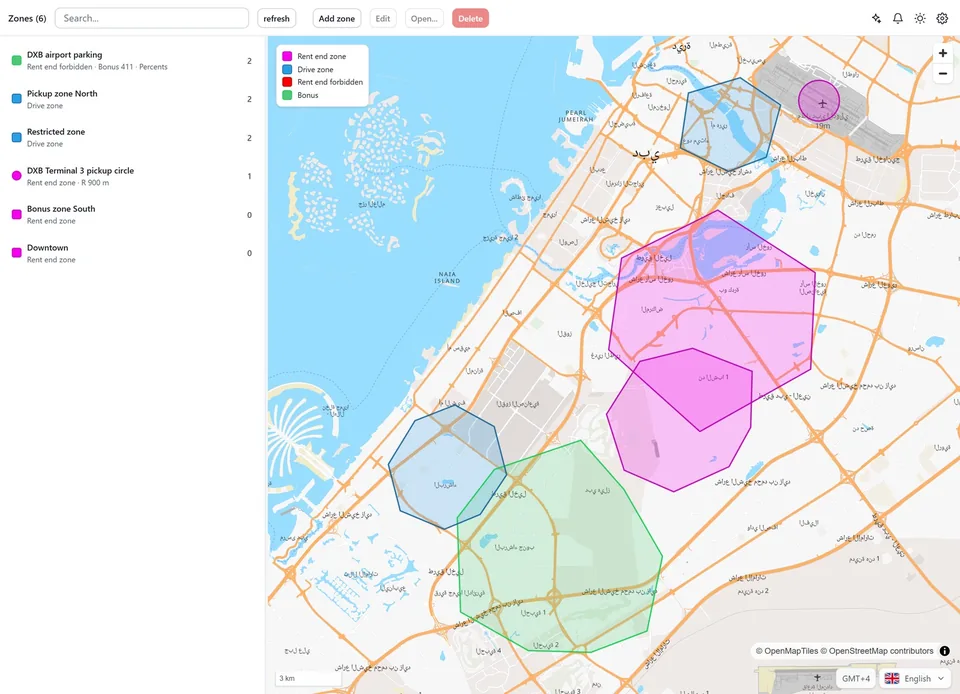
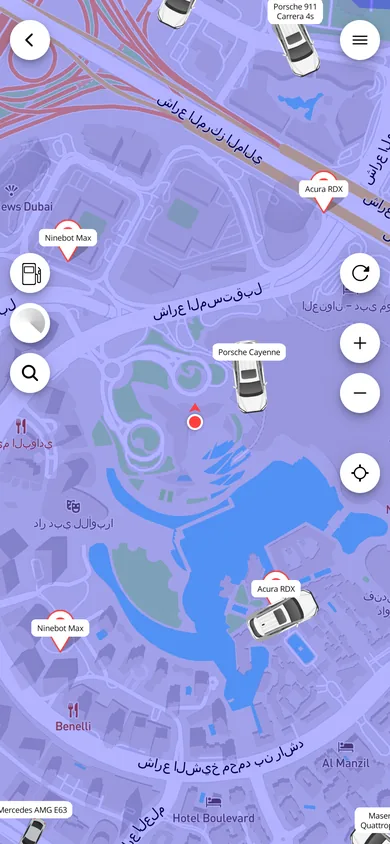
Zones. Rent-end zones, drive zones, restricted zones and an airport parking zone drawn on the map. Customers see the available cars around them in the app.
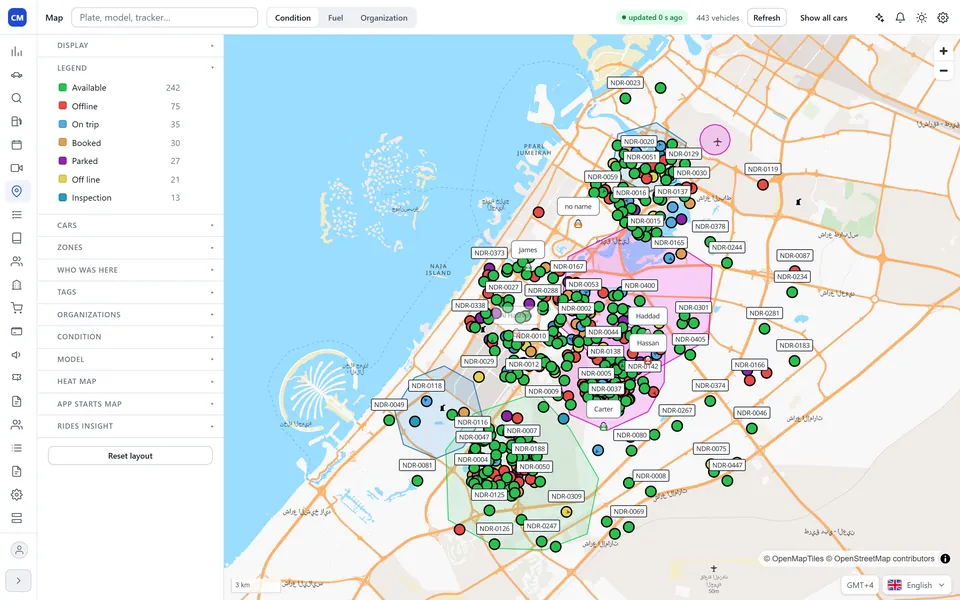
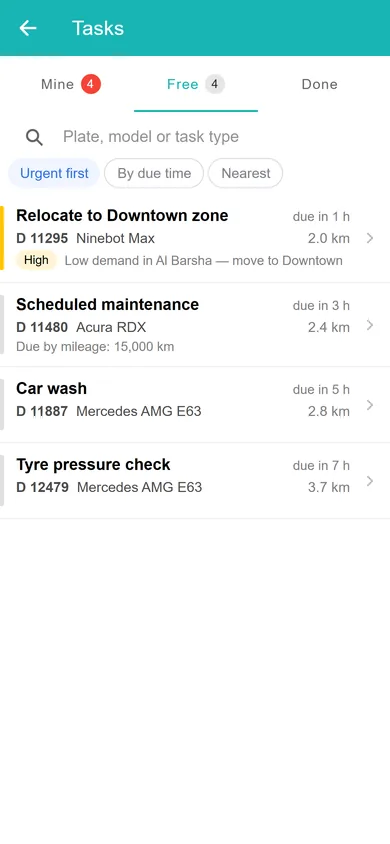
Fleet and field team. Every vehicle and its status on one live map. Open tasks wait in the technician app, where any free technician can take the nearest one.
Payments Canada counted 26.7 billion retail payments in 2025, with credit cards at 43 per cent of the volume and debit cards at 25 per cent (source). A car sharing service asks a card to hold money before the trip and take the final amount after it.
Stripe’s documentation says an authorisation for an online card payment is usually valid for 7 days, 4 days and 18 hours for a Visa payment started by the merchant, and the funds are released if they aren’t captured in time (source). Our reading: a hold taken when someone books a week ahead may lapse before the trip starts.
One rental can carry more than one tax. British Columbia’s PST guide says a passenger vehicle rental tax of $1.50 per day, or portion of a day, applies on top of PST to passenger vehicles rented for more than 8 consecutive hours and 28 consecutive days or less. The lessor collects it and reports it on the PST return; GST is charged on that tax, PST is not (source). Our reading: a two-hour trip stays under the 8-hour line and a weekend booking crosses it. Which taxes apply to a rental by the minute in your province is a question for your accountant.
Modo, a car sharing co-operative in British Columbia, says its fleet is insured up to $5 million under a third-party liability policy from ICBC and that it covers damage to its own cars itself (source). Get your own insurer’s conditions in writing before you choose hardware.
Our side: we’ve integrated more than 15 payment gateways, including Stripe, PayPal, Apple Pay and Google Pay, and several can run at the same time. The billing module handles deposits, refunds and unpaid invoices, and payments can run in several currencies; confirm yours with the gateway you choose. Our site says nothing about calculating Canadian sales taxes, so bring your accountant’s answer to the first call.
Communauto, founded in 1994, calls itself the manager of the oldest car-sharing service on this side of the Atlantic and works in sixteen Canadian cities (source). INVERS counted at least 70 operators in the US, Canada and Mexico in July 2024, named Communauto, Evo Car Share and Modo in Canada, and found a very high ratio of shared cars per capita there (source). Toronto, by its staff’s count in June 2026, has one active free-floating operator (source).
The operators we can name are in Europe: Anytime in Prague, with more than 600,000 rentals since 2019, RideNow in Cyprus, with more than 500 cars, and AnyGo in Belgrade. We’ve been on the market since 2015. If you also run cars south of the border, see our page on car sharing software for the United States.
There’s no setup fee. The monthly fee is by quote, per active vehicle, with discounts for larger fleets, and you can start with one vehicle. Each car needs a telematics unit; we work with devices such as Teltonika and quote the hardware after we’ve reviewed your car models. A launch takes about 15 days once the vehicles and hardware are ready.
With 10 to 50 cars, look at each vendor’s monthly minimum first. Wunder Mobility publishes one of EUR 18,250 with 500 vehicles included (source). Our pages on CT Mobility as an ATOM Mobility alternative and as a Wunder Mobility alternative put the published prices side by side.
Before the first call with us or with anyone else:
CT Mobility Solutions F.Z.C. · E-Commerce Hub BC-8, Ajman Free Zone C1 Building, Ajman Free Zone, Ajman, United Arab Emirates
Yes. Customers pass ID and driving licence verification with liveness detection before they get access to a car, and identity verification platforms such as Sumsub can be connected. Other providers can be integrated on request. Which Canadian licences the document check reads is a question to send us with sample images.
Yes. Supported vehicle types include cars, scooters and e-scooters, bicycles and e-bikes and mopeds, managed in one console. See scooter sharing software.
Yes. Employees book a pool car in the app, open it with their phone and return it to the company parking. Bookings can be limited by role, team and usage schedule. See corporate car sharing software.
We have repeatedly proven this in practice with dozens of launched projects and years of successful work. Ask our clients who have tried several IT solutions but still remain with us.




