Sooner or later finance asks the fleet or office manager a short question: what does a pool car cost us? The honest answer is a number per month and a number per kilometre, and you can build both from bills you already have.
Short answer: Monthly cost = yearly fixed costs (depreciation or lease, insurance, registration, financing) ÷ 12 + cost per km × km driven + usage costs (Salik, parking, fines the company keeps, cleaning, admin time); cost per km = monthly cost ÷ km driven.
Last updated:
November 20, 2026
Sort every cost by what makes it grow. Some lines arrive whether the car moves or not. Some grow with each kilometre. The rest depend on where and when the car is driven.
| Group | Cost lines | Where the figure comes from |
|---|---|---|
| Fixed (per year) | Depreciation or the lease payment, insurance, registration renewal, financing if the car was bought on credit | Purchase invoice and your own resale estimate, the insurance policy, the RTA renewal receipt, the loan schedule |
| Per kilometre | Fuel, tyres, servicing and repairs | Fuel card or receipts, workshop invoices, odometer |
| Per trip or use | Salik, parking, fines the company ends up paying, cleaning | Salik statement, parking app, fines list, car wash bills |
| Admin time | Handing out keys, filling in the logbook, matching fines to drivers, booking the service | Nobody sends a bill for it; estimate hours per month and an hourly cost |
The last row is the one most cost sheets leave out. In a company with a key box at reception and a paper logbook, someone spends part of every week on it, and that time belongs to the car.
Depreciation is the line people argue about. Use (purchase price − expected resale value) ÷ years you plan to keep the car. The resale value is your company's own estimate. Write down where it came from (a dealer's buy-back offer, your last sale of a similar car) so the next person can check it.
One row per car, one column per line, and three results at the end:
Fuel per km is the price per litre × litres per 100 km ÷ 100. Tyres per km is the price of a set ÷ the km you expect it to last, and servicing works the same way with your service plan. For a leased car the lease payment replaces depreciation and financing; check what else the lease already covers so nothing is counted twice.
VAT and how these costs appear in the books are a question for your accountant. The formula works the same with or without it as long as every line is treated the same way.
Here's a sedan in the pool of a company in Al Quoz, used by sales staff for client visits in November 2026. The tariffs in it are the public ones; the purchase price, resale value, insurance, consumption, servicing, kilometres and hours are illustrative round numbers, so put your own in their place.
Public tariffs used, as published on 19 November 2026:
| Line | How it is worked out | AED this month |
|---|---|---|
| Depreciation | (80,000 − 32,000) ÷ 4 years = 12,000 a year | 15,405 ÷ 12 = 1,283.75 |
| Insurance | 3,000 a year | |
| Registration renewal | 405 a year (bought for cash, so no financing line) | |
| Fuel | 8 l per 100 km × 4.04 = 0.3232 per km × 2000 km (160 litres) | 646.40 |
| Tyres | 1,600 a set ÷ 40000 km = 0.04 per km × 2000 km | 80.00 |
| Servicing | 1,200 per 20000 km = 0.06 per km × 2000 km | 120.00 |
| Salik | 36 peak crossings × 6.30 + 24 off-peak crossings × 4.20, VAT included | 327.60 |
| Parking | 20 hours in Zone A × 4.2 | 84.00 |
| Fines kept by the company | One speeding fine, passed to the driver under the vehicle policy | 0.00 |
| Cleaning | 4 washes × 30 | 120.00 |
| Admin time | 3 hours × 80 an hour | 240.00 |
| Total | 2000 km driven | 2,901.75 |
That gives AED 2,901.75 for the month and AED 1.45 per km (2,901.75 ÷ 2000 = 1.451). November 2026 has 21 weekdays, so a working day of this car costs AED 138.18.
This is roughly how the conversation with finance goes:
“What did the Al Quoz sedan cost us in November?”
“AED 2,901.75, or AED 1.45 a kilometre. AED 1,283.75 of that we pay even if nobody drives it.”
“And if it had done half the kilometres?”
“The fixed part alone would be AED 1.28 per km instead of AED 0.64. The car gets cheaper per km the more it's used.”
Watch the fines row. It's zero here because the trip record named the driver and the policy says the driver pays. Without that record the fine stays with the company and lands in this table.
When a lease quote lands on your desk, compare it only with the lines the lease would cover. The lease payment replaces depreciation. If the quote also includes insurance, registration, tyres and servicing, our sedan's comparable figure is 1,000 + 250 + 33.75 + 80 + 120 = AED 1,483.75 a month. Fuel, Salik, parking and cleaning stay with you either way.
The same sheet tells you which pool car hardly earns its place: high cost per km, few trips. And if departments are charged for cars, each department's km times the cost per km gives its share of the bill.
How much a car is used is a separate measure. Our article on fleet utilisation and how to calculate it covers the hours, and fleet efficiency: how to measure and improve it covers the other measures.
Inside the platform · demo data
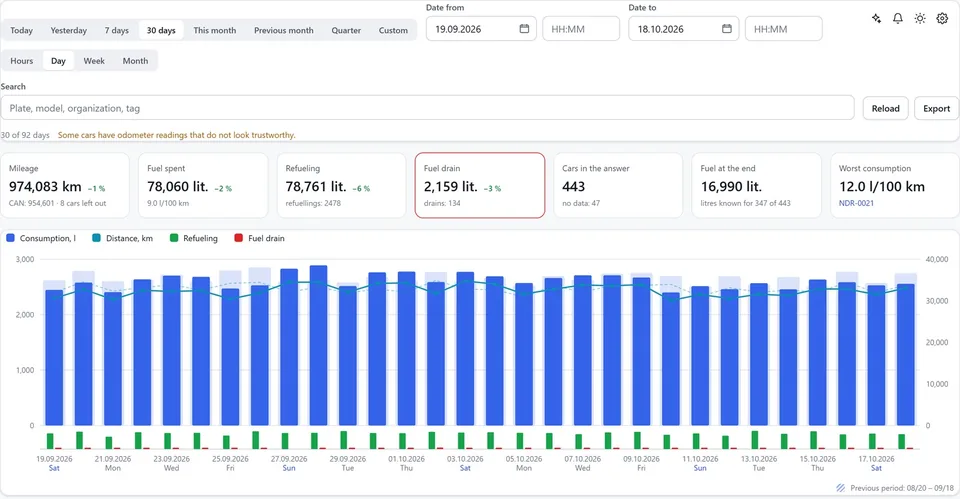
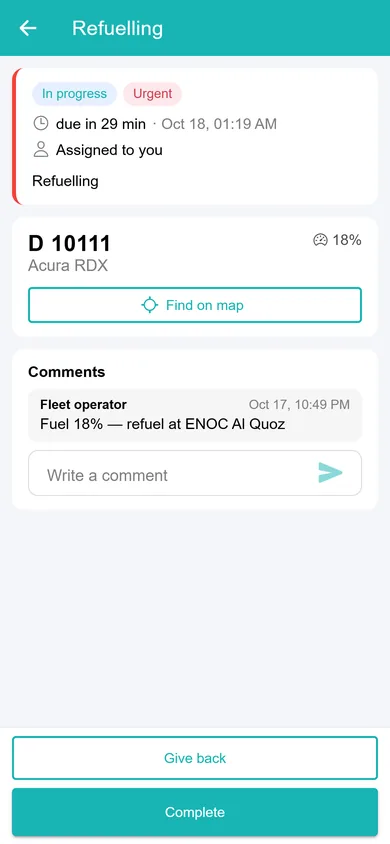
Fuel and mileage. Mileage, fuel spent, refuelling and suspected fuel drains per day for the whole fleet. A car low on fuel becomes an urgent refuelling task in the technician app.
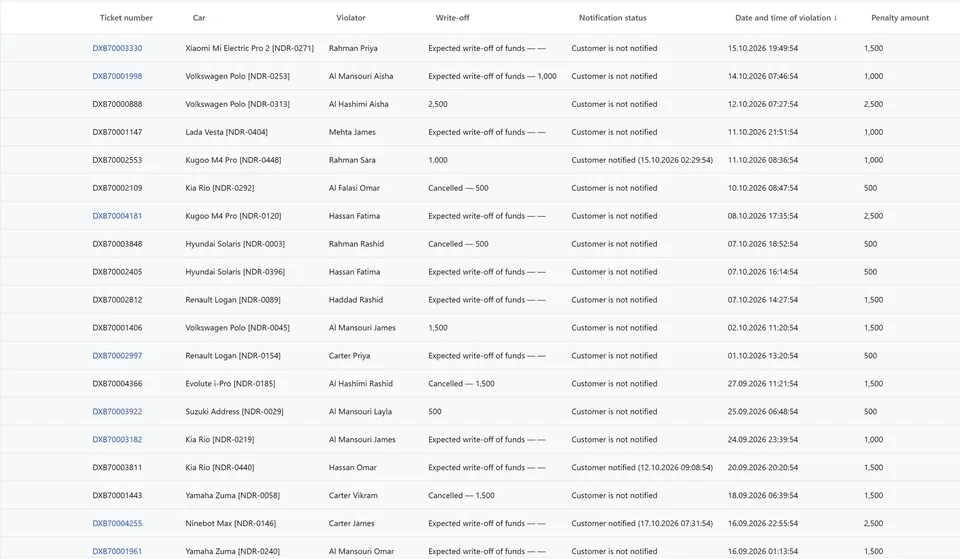
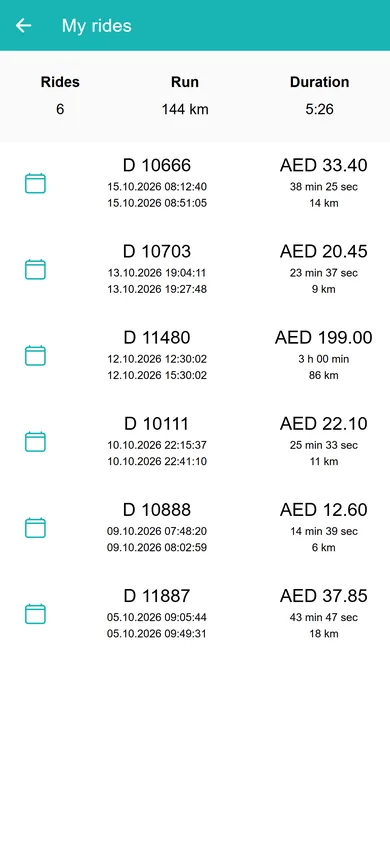
Fines matched to drivers. Each unpaid fine is matched to the car and to the driver who had it at the time of the violation, with the amount in AED. Drivers see their own trips with time, distance and cost in the app.
Most lines need one document each. Fuel comes from the fuel card statement or the receipts, Salik from the monthly Salik statement, fines from the RTA fines list for the plate, and kilometres from the odometer reading on the last day of the month (photograph it). Insurance, registration and depreciation change once a year, so they sit in the sheet and you only check them at renewal.
What to do tomorrow morning:
In CT Mobility every trip is recorded with the driver, route, fuel and photos, and the history keeps the start and end time, route and mileage of each booking. Traffic fines and Salik tolls are matched to the employee through the trip history: take the plate and time from the fine or the Salik statement and find the trip that covered that minute. See pool car management in the UAE.
Pilot for UAE companies: we connect up to 2 of your vehicles with no subscription fee for 3 months, so you can judge the results on your own operations before any commitment. Only the hardware, installation and mobile data are paid. Go live in about 15 days.
CT Mobility Solutions F.Z.C. · E-Commerce Hub BC-8, Ajman Free Zone C1 Building, Ajman Free Zone, Ajman, United Arab Emirates
For a pool car driven by staff who have other jobs, we'd leave it out: the employee is paid anyway. For a car with a dedicated driver, add the driver's monthly cost as a fixed line. Either choice works if the sheet says which one you made.
Electricity replaces fuel: kWh per 100 km × price per kWh ÷ 100 gives the energy cost per km. Count home or office charging at the rate on your electricity bill and public charging at the rate on the charging receipt. The other lines stay the same.
We have repeatedly proven this in practice with dozens of launched projects and years of successful work. Ask our clients who have tried several IT solutions but still remain with us.




