Take a rent a car company in Al Quoz with 60 cars on daily and monthly contracts. The owner wants to put 30 of them on the street and rent them by the minute through an app, the way the hourly services in Dubai already do. What has to happen, and in what order? The company and its numbers are made up for this guide; the rules and fees are quoted from the sources linked in the text.
Short answer: Car sharing in Dubai is licensed as hourly vehicle rental. You need a permit from the RTA’s Licensing Agency (AED 2,000 to issue or renew, plus AED 150 for each vehicle), cars fitted with tracking, a system that rents only to registered users with a recognised driving licence, and a payment gateway paying into your own merchant account. The platform is the quick part, about 15 days once cars and devices are ready. Apply for the permit and the merchant account first.
Last updated:
November 13, 2026
Hourly rental in Dubai runs under Executive Council Resolution No. 49 of 2016. It defines the activity as renting out vehicles for short periods to travel within the emirate, and Article 3 is blunt: no one may conduct it without a permit. The permit comes from the RTA’s Licensing Agency, lasts a year and is renewable. The fee schedule at the end puts a number on it: AED 2,000 to issue or renew the permit and AED 150 for each vehicle’s operating authorisation. For our 30 cars that’s AED 6,500 in the first year, before anything else.
A Gulf News guide updated in November 2023 says RTA had licensed three companies for the service: Udrive, ekar and Yaldi. So the door isn’t wide open, and the first conversation is with RTA. Ask what the implementing bylaw requires today: the minimum number of cars, parking, the daily limit per user and the rates. The 2016 text and later press coverage don’t agree on the daily limit, so get the current figure from RTA.
We sell software, so take this section as a reading list and get the legal answer from RTA or your lawyer.
Article 5 lists the operator’s duties. Eight of them are really questions about software, and they make a good first filter for any platform you look at.
| In the resolution | What to check in a platform |
|---|---|
| Rent only to users registered on the system (Art. 5(16)) | Every trip belongs to one registered account. No guest unlocks, no shared logins |
| The renter holds a driving licence recognised by the RTA (Art. 5(11)) | Licence photo and expiry date captured at sign-up, a liveness check against the ID, and a block when the licence expires |
| Vehicles carry a geographic tracking system (Art. 5(22)) | A telematics unit in every car, and an alert when a unit stops reporting |
| Keep registers of vehicle movements and locations (Art. 5(12)) | Trip history with route, start and end time that you can export for any car and date |
| Connect your electronic system to the RTA’s rental information system (Art. 5(15)) | An open API. Ask RTA what the link looks like today, then ask the vendor to scope it |
| Charge the rates prescribed by the RTA (Art. 5(13)) | Tariffs you can edit yourself the day a rate changes |
| Use the car parks and places designated for the activity (Art. 5(6)) | Trip-end zones on the map, and a clear message in the app when a customer tries to end outside them |
| Use the standard contract approved by the RTA (Art. 5(17)) | The approved contract text shown and accepted in the app at sign-up |
The row people skip is the link to the RTA system. Nobody outside can tell you what that link looks like this year. RTA can, and a vendor with a documented API can then tell you how long it takes.
Inside the platform · demo data
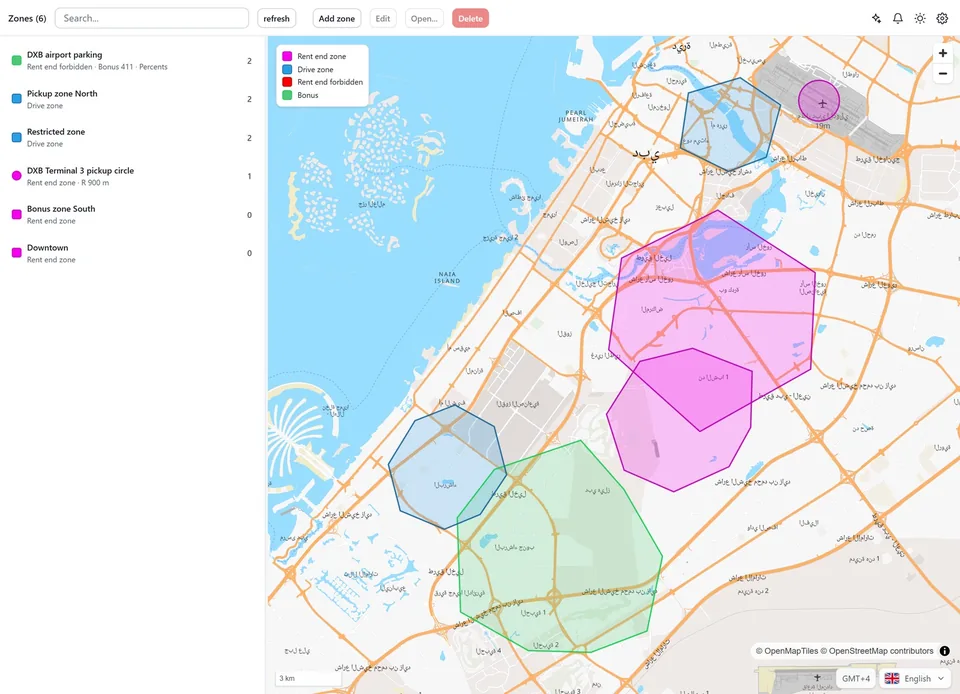
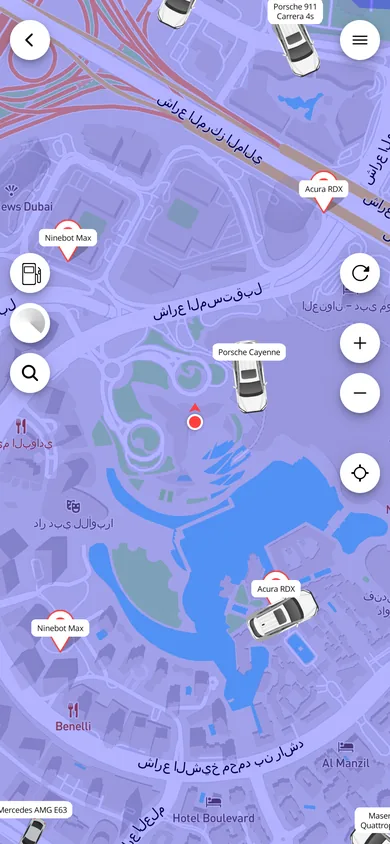
Zones. Rent-end zones, drive zones, restricted zones and an airport parking zone drawn on the map. Customers see the available cars around them in the app.
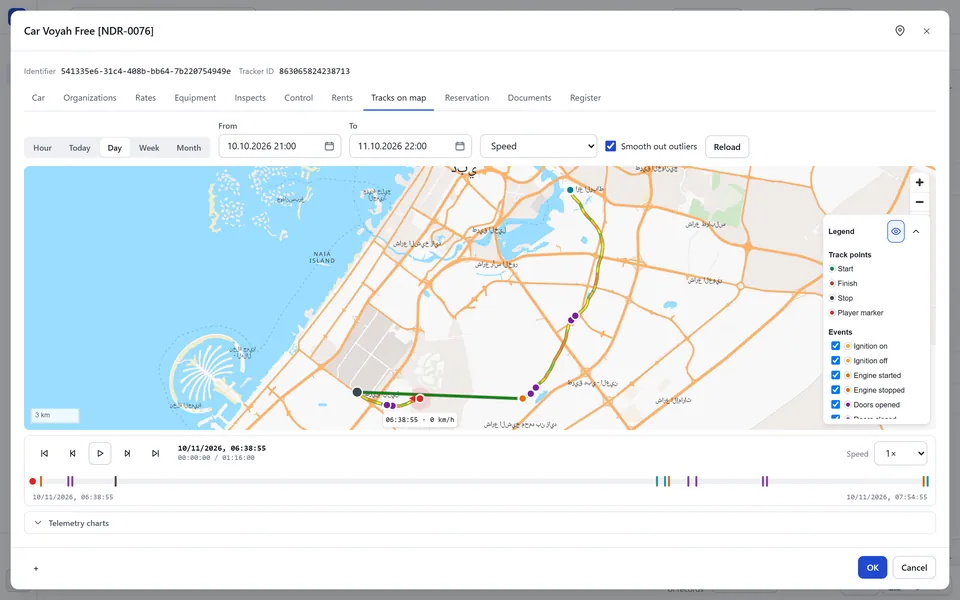
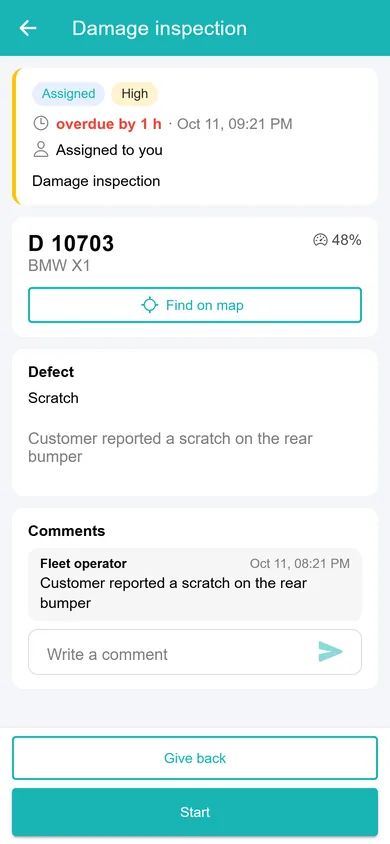
Trip history. Replay any trip with ignition, door and speed events to see exactly who drove and how. Damage reported by a customer becomes a task for your team.
Who may rent? The Gulf News guide describes the practice of the licensed services: drivers of at least 21 with six months of driving experience, an Emirates ID and a driving licence for residents, a passport copy and a licence or international driving permit for tourists, and a card on file. Your sign-up flow has to collect exactly that and refuse the rest. Test it with an expired licence and with a visitor’s licence before a customer does.
Then money. A payment gateway pays out to a merchant account in your company’s name, and opening one is paperwork between you and the provider. It can take longer than the app. Start it the week you approach RTA, and ask each platform which gateways it has live today and what a new one costs in time.
Price inside the rates RTA prescribes. The same guide quotes a minimum fare of 50 fils a minute (AED 30 an hour), with fuel, parking and insurance included and Salik and fines charged to the renter.
Back to Al Quoz. This is the order we’d run it in.
Step five is the one we wouldn’t skip. A trip that won’t end at 01:00 on a Saturday is a support call, a refund and a one-star review, and it’s much cheaper to meet it with a colleague in the car. We wrote up that exact case in when a customer cannot end the trip.
Our own answers are on the car sharing software for Dubai and the UAE page. The short version: we’re in Ajman and install in every emirate, the price is AED 50 per car per month with a minimum of AED 500 and the devices quoted per model, and Anydrive in Dubai runs its app-based rental on the platform.
If ATOM Mobility is on your shortlist too, we’ve put the public facts about both platforms side by side in CT Mobility as an ATOM Mobility alternative.
CT Mobility Solutions F.Z.C. · E-Commerce Hub BC-8, Ajman Free Zone C1 Building, Ajman Free Zone, Ajman, United Arab Emirates
Yes. On CT Mobility the same car can be offered on daily or monthly rental and by the minute, with separate tariffs, so a rental company can move cars between the two as demand changes. Whether a car licensed for daily rental may be used for hourly rental is a question for RTA.
Resolution No. 49 of 2016 applies to the Emirate of Dubai. The other emirates have their own transport authorities and rules, so start with the authority of the emirate where the cars will be parked.
We have repeatedly proven this in practice with dozens of launched projects and years of successful work. Ask our clients who have tried several IT solutions but still remain with us.




